
Our Tech Stack Exposed: Flutter, n8n, and Claude — What Actually Works (and What Doesn't)
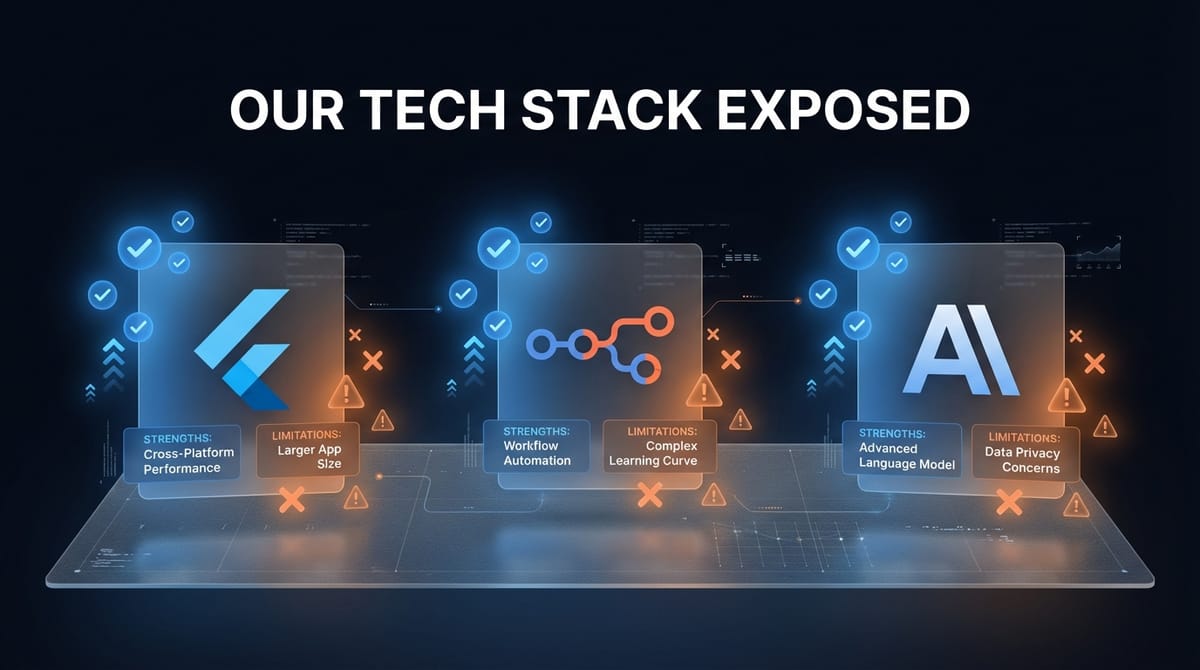
Most "tech stack" posts are thinly veiled sales pitches. This isn't one of those.
At Etere Studio, we've built our entire practice around three core tools: Flutter for mobile apps, n8n for automation, and Claude for AI-assisted workflows. We've shipped dozens of projects with this stack. Some things work brilliantly. Others have made us want to throw our laptops out the window.
Here's the honest breakdown — the wins, the gotchas, and when you actually need help versus when you can figure it out yourself.
Why We Chose Each Tool
Let's start with the reasoning. Every tool in our stack solves a specific problem we kept running into.
Flutter replaced the nightmare of maintaining two codebases. Before Flutter, we'd quote 12 weeks for an MVP and spend 8 of those weeks fixing platform-specific bugs. Now we ship in 6-8 weeks with a single codebase that actually looks native on both platforms.
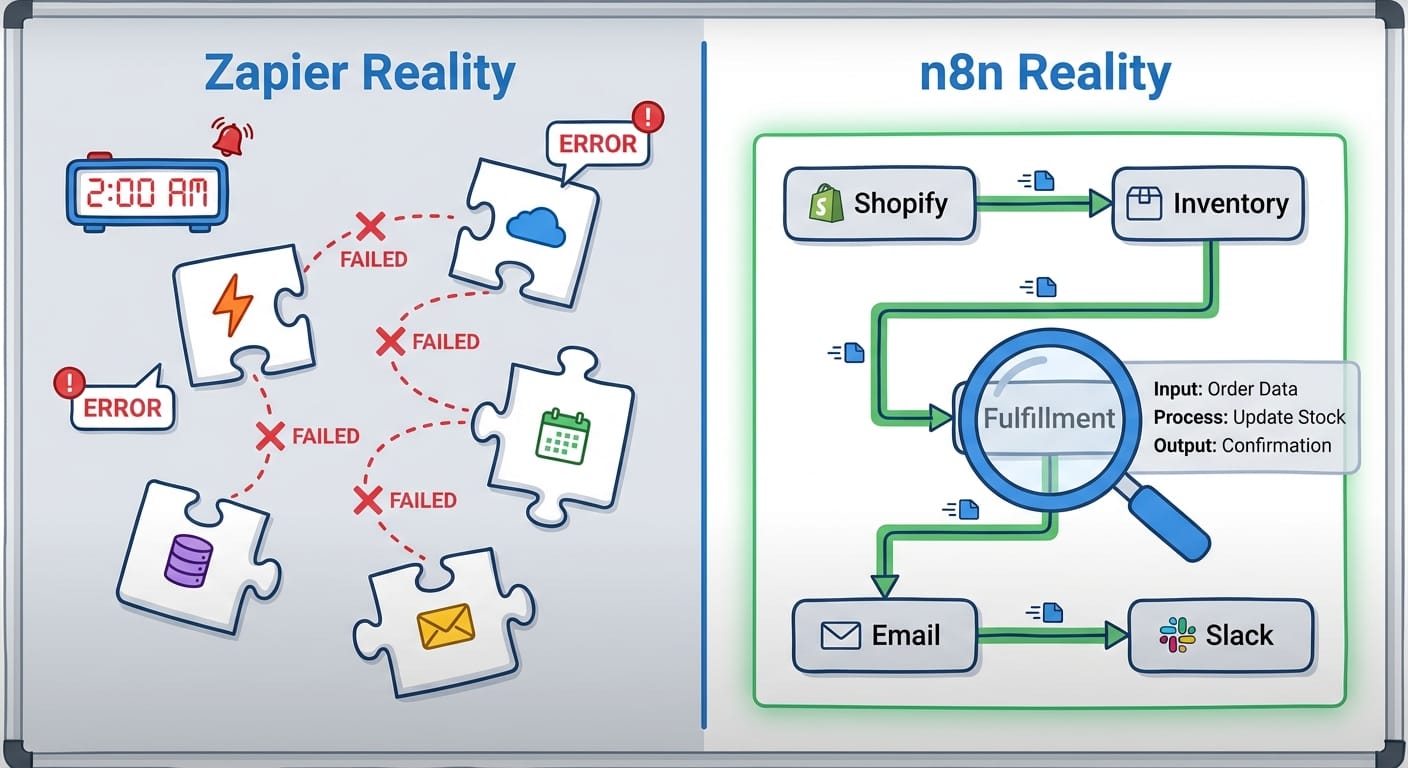
n8n replaced the duct-tape automations we used to build with Zapier. When a client's Zap broke at 2am because of a rate limit, and their entire order flow stopped — that was the last straw. We needed something self-hosted, inspectable, and not beholden to someone else's pricing tiers.
Claude replaced the copy-paste-into-ChatGPT workflow that was eating hours every week. We needed something we could integrate into actual systems, not just chat with in a browser tab.
The common thread: control. We wanted tools that let us see what's happening, fix what breaks, and scale without asking permission.
What Actually Works
Let's talk wins. These are the things that have genuinely delivered on the promise.
Flutter: One Codebase, Real Native Feel
The hot reload alone is worth it. Change a widget, see it instantly. No rebuild, no waiting. For a team that iterates fast with clients, this is transformative.
But the bigger win is consistency. When we build a feature, it works the same on iOS and Android. Not "mostly the same" — actually the same. We had a fintech client who needed pixel-perfect UI across both platforms. In React Native, we would've spent weeks on platform-specific tweaks. In Flutter, we spent zero.
The widget system clicks once you understand it. Everything is a widget, composition over inheritance. It felt weird at first, coming from traditional mobile development. Now it feels obvious.
n8n: Automation You Can Actually Debug
The visual workflow builder isn't just pretty — it's functional. When something breaks, you can see exactly where. Click on a node, see the input, see the output, see the error. No digging through logs.
We built an order processing system for an e-commerce client. Shopify webhook → inventory check → fulfillment API → customer notification → Slack alert. In Zapier, this would've been five separate Zaps with prayer holding them together. In n8n, it's one workflow with proper error handling.
Self-hosting means we control the data. For European clients with GDPR concerns, this isn't optional — it's required. We run n8n on a €20/month VPS and it handles thousands of executions daily.
Claude: AI That Follows Instructions
Claude's system prompts actually work. You can give it a persona, rules, constraints, and it follows them. We've built internal tools where Claude processes incoming leads, extracts key information, and routes them appropriately. The consistency is remarkable.
The API is straightforward. No weird authentication dances, no confusing tier structures. You pay for tokens, you get tokens. We integrated Claude into a client's support workflow in an afternoon.
The context window is genuinely useful. We can feed it an entire codebase summary and get coherent answers about architecture decisions. Try that with a 4K context limit.
What Doesn't Work (The Gotchas)
Now the uncomfortable part. Every tool has sharp edges, and pretending otherwise helps no one.
Flutter: The Learning Curve Is Real
Dart is not JavaScript. It's not Swift. It's not Kotlin. It's its own thing, and developers coming from other backgrounds will struggle for the first few weeks. We've seen senior iOS developers take a month to feel productive.
The state management situation is… a lot. Provider, Riverpod, Bloc, GetX, Redux, MobX — the ecosystem can't agree on anything. At Etere Studio, we've standardized on Riverpod, but we spent months evaluating options. A startup trying to figure this out while also building product? That's a recipe for wasted time.
Platform-specific stuff still hurts. Need deep integration with HealthKit? Native Bluetooth LE with specific protocols? Camera access with custom processing? You'll be writing platform channels and native code. Flutter's promise of "one codebase" has asterisks.
And the app size. A minimal Flutter app is 15-20MB. For most apps, this doesn't matter. But if you're building for emerging markets with download size sensitivity, it's a real consideration.
n8n: Self-Hosting Means Self-Maintaining
The cloud version is expensive at scale. The self-hosted version is free but requires ops knowledge. There's no middle ground.
We've had n8n instances crash because of memory leaks in specific nodes. We've had workflows silently fail because of timezone issues. We've spent weekends debugging why a webhook stopped receiving data (it was a reverse proxy configuration, obviously).
The documentation is… improving. But for complex use cases, you're often reading source code or GitHub issues. Community support is good, but it's not "call someone at 3am" good.
Error handling requires discipline. n8n won't stop you from building fragile workflows. You have to add error nodes, set up alerts, think about retry logic. The tool gives you rope; it's up to you whether you climb or hang.
Claude: Not Magic, Still AI
Hallucinations happen. Less than other models, but they happen. We had Claude confidently generate API documentation for endpoints that didn't exist. If you're not validating outputs, you're building on sand.
The pricing adds up. For high-volume use cases, costs can surprise you. We had a client who wanted to process every customer email through Claude. The math didn't work — we ended up using Claude for complex cases and rule-based systems for simple ones.
Rate limits exist. During peak times, you'll hit them. Build retry logic, build fallbacks, or build frustration.
And the model changes. Anthropic updates Claude, and suddenly your carefully tuned prompts behave differently. We've had to rewrite system prompts three times in the past year because of model updates. Version pinning helps, but it's not perfect.
The Complexity Question
Here's the honest truth about learning curves:
Flutter: 2-3 months to be productive, 6-12 months to be good. If you're a startup founder thinking you'll "learn Flutter on the side," you're underestimating it. This is a real skill that takes real time.
n8n: 1-2 weeks for simple workflows, 2-3 months for complex ones. The visual interface is deceptive — it looks easy until you need error handling, data transformation, or custom logic. Then it's programming with extra steps.
Claude: Hours to start, weeks to use well. Anyone can send a prompt. Building reliable, consistent AI systems requires understanding tokens, context, prompt engineering, and failure modes. It's a discipline, not a feature.
When You Need Experts vs. DIY
This is the question we get most often. Here's our honest take:
You Can DIY If:
- You're building a simple Flutter app with standard UI patterns and no complex native integrations
- Your n8n workflows are linear (A → B → C) with well-documented APIs
- You're using Claude for internal tools where occasional errors are acceptable
- You have time to learn and iterate, and shipping fast isn't critical
- Your team has at least one technical person who can debug when things break
You Need Experts When:
- Your Flutter app needs custom native code, complex state management, or performance optimization
- Your n8n workflows involve multiple failure points, complex data transformations, or need to be bulletproof
- You're building customer-facing AI features where consistency and reliability matter
- Time-to-market is critical and learning curves would cost you more than hiring
- You don't have technical people who can maintain what gets built
The meta-lesson: the tools are accessible, but production-grade implementations require experience. The gap between "it works on my machine" and "it works reliably at scale" is where expertise lives.
The Honest Summary
Our tech stack for startups works because we've invested years learning its edges. Flutter is genuinely excellent for cross-platform apps — if you understand its constraints. n8n is powerful automation — if you're willing to maintain it. Claude is transformative for AI workflows — if you build for its failure modes.
No stack is perfect. Anyone telling you otherwise is selling something.
The right question isn't "what's the best stack?" It's "what's the best stack for your specific situation, constraints, and team?" Sometimes that's Flutter + n8n + Claude. Sometimes it's WordPress and Zapier. Sometimes it's custom everything.
We've helped teams figure out which path makes sense for them. If you're making these decisions and want a second opinion, we're happy to chat. Get in touch