
How a Logistics SME Replaced Their Enterprise ERP with Custom n8n Workflows and Saved €185K Annually
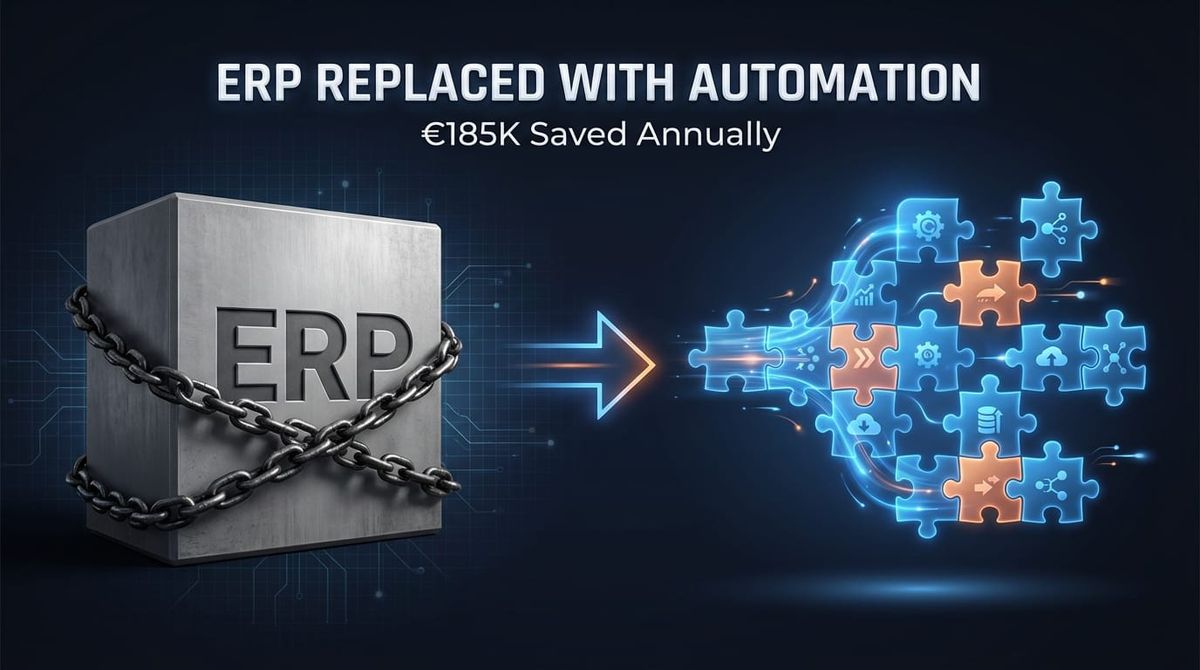
A mid-sized logistics company in the Netherlands was spending €200,000 annually on an enterprise ERP system they barely used. Most features sat idle. The ones they needed didn't work how they worked. Every customization request took months and cost thousands more.
After six weeks and €15,000, we replaced the entire system with modular n8n workflows tailored to their actual processes. First-year savings: €185,000. More importantly, they can now change things themselves in hours instead of filing tickets and waiting.
This isn't a one-off. We're seeing this pattern repeat across SMEs: rigid enterprise software that costs more to maintain than replace.
The ERP Trap for SMEs
Enterprise resource planning systems were built for enterprises. Fortune 500 companies with dedicated IT teams, complex approval chains, and processes that don't change often. For a 50-person logistics company moving 200 shipments a day, it's overkill.
The client came to us after two years of frustration. Their ERP handled accounting and basic inventory tracking, but core operations still lived in spreadsheets and email. Why? Because the ERP couldn't map to how they actually worked.
They needed to:
- Track shipments across multiple carriers with different APIs
- Generate custom packing lists based on destination country regulations
- Send automated status updates to customers via WhatsApp (their primary communication channel)
- Flag high-value shipments for manual review
- Sync with their accounting software, but not replace it
The ERP vendor quoted €40,000 and 8 months for WhatsApp integration alone. The rest was "not currently on the roadmap."
Meanwhile, they were paying:
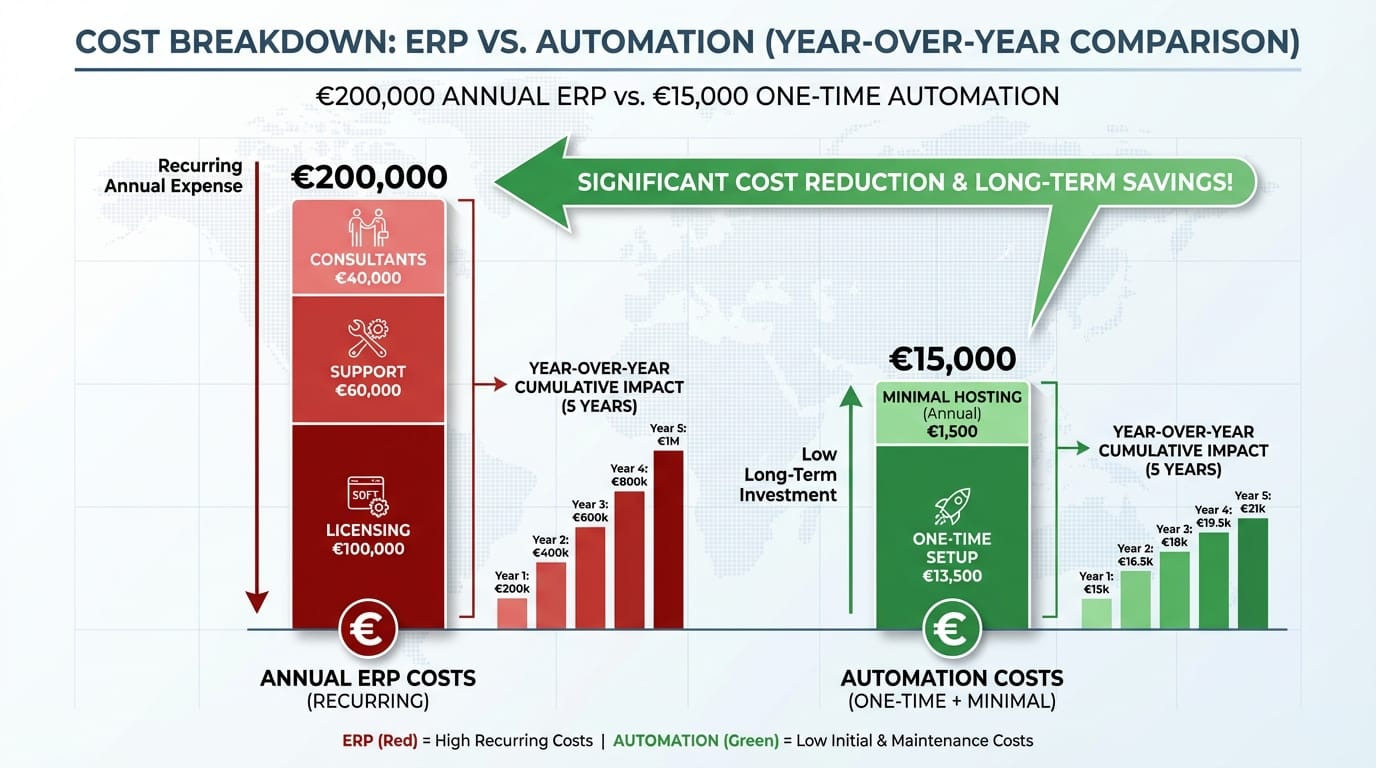
- €180,000/year in licensing (tiered by users and modules)
- €20,000/year for support contracts
- €15,000-30,000 annually for consultant hours
And still maintaining spreadsheets.
The Modular Automation Approach
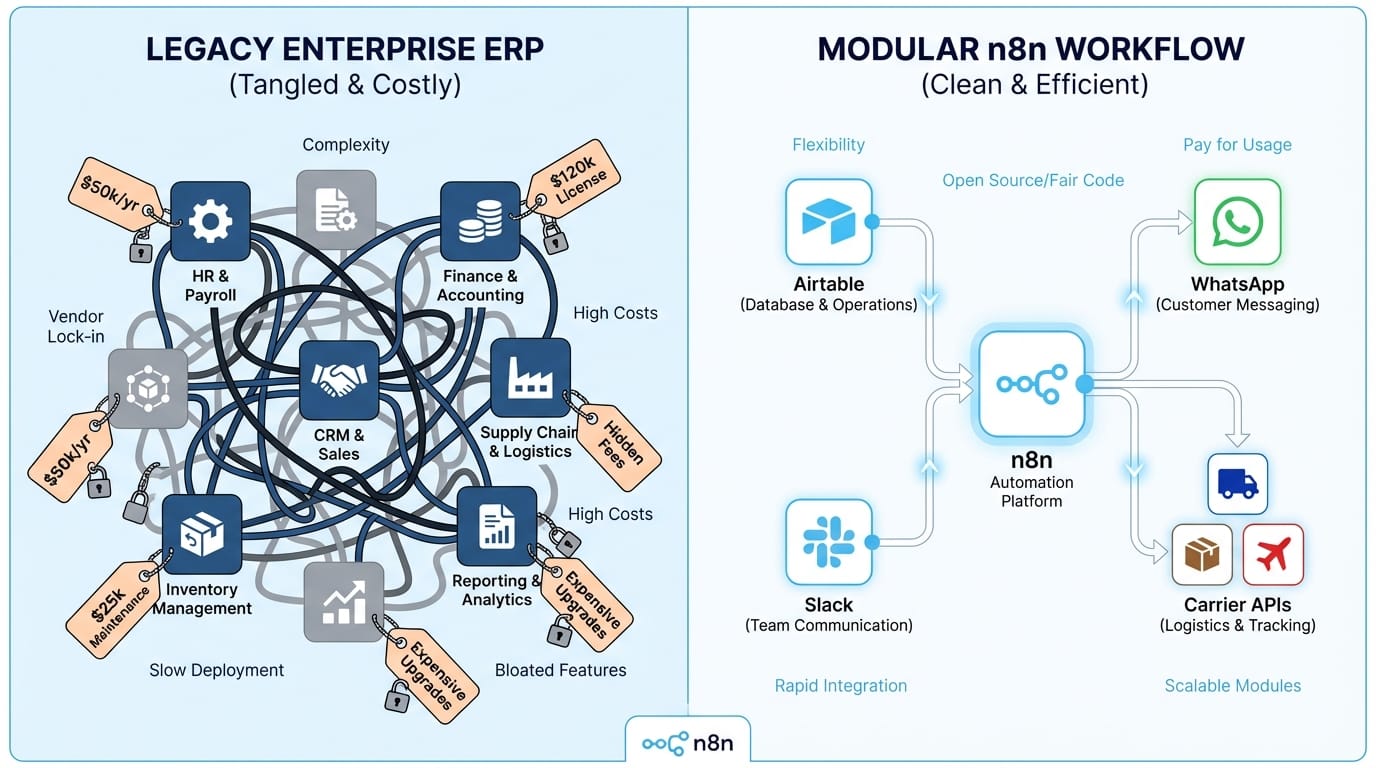
At Etere Studio, we've built enough custom automation to know what works for SMEs. The answer isn't another monolithic system. It's targeted workflows that connect existing tools.
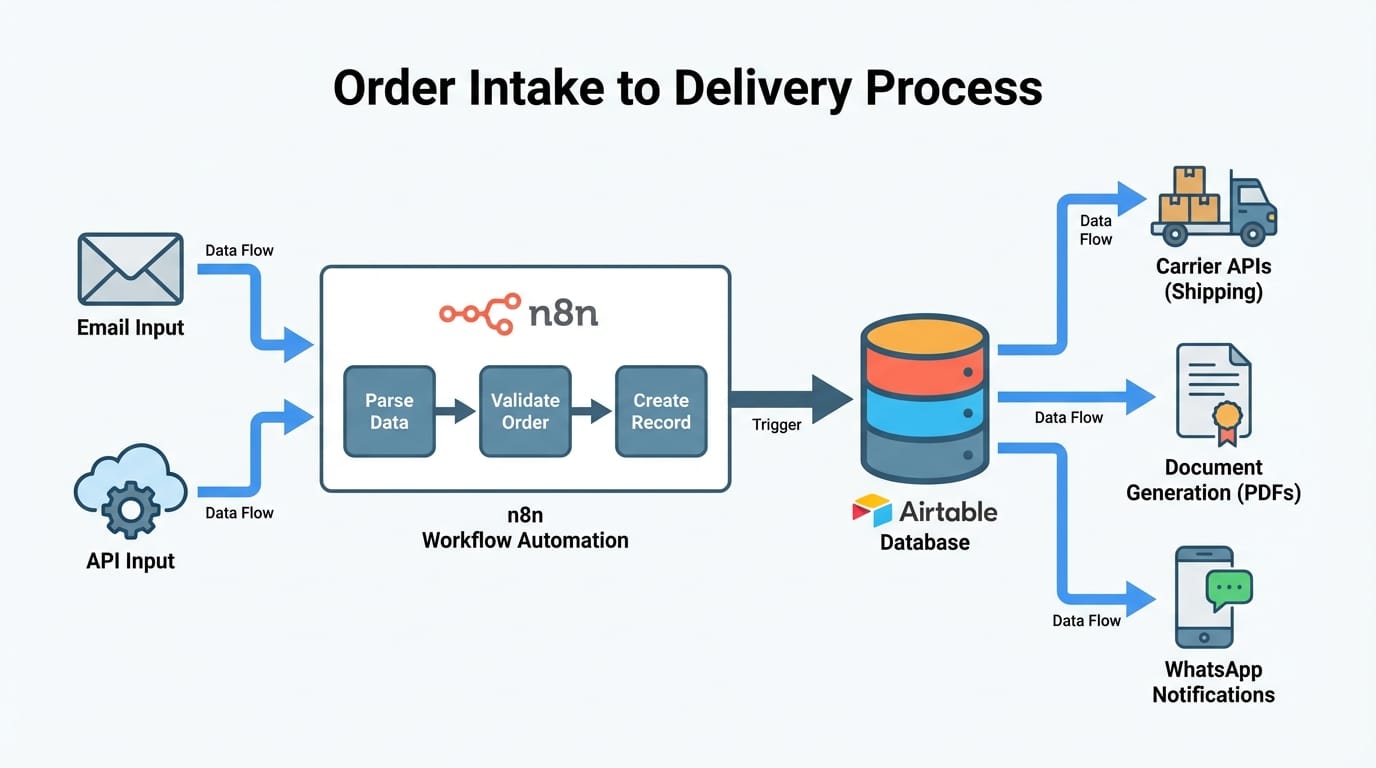
We mapped their operations into six core workflows:
Order Intake Workflow
New orders arrive via email, API, or web form. n8n parses data, validates addresses against carrier APIs, calculates costs using their rate tables (Google Sheets), creates records in Airtable (their new lightweight database), and sends confirmation emails.
Carrier Integration Workflow
When an order is ready to ship, the workflow generates labels through carrier APIs (DHL, UPS, FedEx, local couriers). Different carriers have different data requirements. The workflow handles that transformation automatically.
Document Generation Workflow
Packing lists, customs declarations, and commercial invoices are generated from Airtable data using templates. Output PDFs attach to shipping records. Country-specific regulations (like EORI numbers for EU) get applied automatically.
Customer Communication Workflow
Status updates go out via WhatsApp Business API as shipments move through stages. Customers reply with questions. Those messages route to the right team member in their existing Slack workspace.
Exception Handling Workflow
High-value shipments, delayed carrier pickups, address validation failures — all flag for manual review. Notifications go to Slack with context and one-click resolution options.
Accounting Sync Workflow
Completed orders export to their existing accounting software (Exact Online) nightly. Revenue, costs, and customer balances stay current without double entry.
Each workflow is independent. Each connects systems they already used (email, Airtable, Google Sheets, Slack, WhatsApp). Nothing forces them into a rigid process.
Cost Reality Check
Here's what they were paying versus what they pay now:
| Category | Old ERP | New Automation | Annual Savings |
|
----------|---------|----------------|----------------|
| Software Licensing | €180,000 | €0 (n8n self-hosted) | €180,000 |
| Support Contracts | €20,000 | €0 | €20,000 |
| Consultant Hours | €20,000 avg | €0 | €20,000 |
| Implementation | N/A | €15,000 (one-time) | N/A |
| Hosting & Tools | €0 | €5,000 | -€5,000 |
| Maintenance | Included | €5,000 | -€5,000 |
| Total Annual | €200,000+ | €15,000 | €185,000 |
The €15,000 setup cost broke down as:
- 2 weeks discovery and workflow design
- 3 weeks development and testing
- 1 week training and handoff
- No ongoing retainer required
They paid back the investment in 28 days of operation.
Timeline Comparison
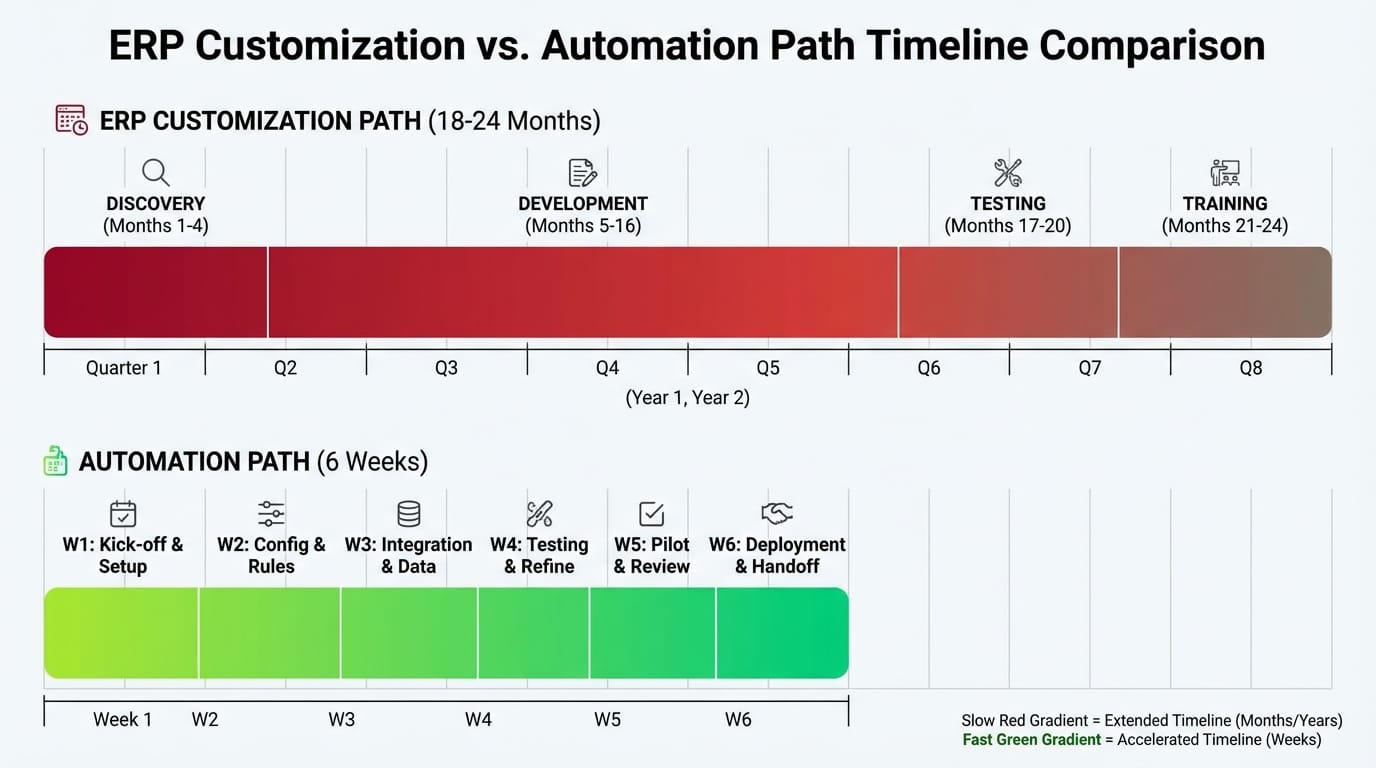
When they originally approached their ERP vendor about customization:
- Initial scoping: 6 weeks
- Development estimate: 12-18 months (phased rollout)
- Testing and UAT: 3-4 months
- Training: 2 months
- Total: 18-24 months minimum
With modular automation:
- Week 1: Process mapping with their team
- Week 2-4: Build first three workflows, test with real data
- Week 5: Build remaining workflows, test end-to-end
- Week 6: Train team, deploy to production
- Total: 6 weeks, fully operational
Speed matters when you're bleeding cash on software that doesn't work.
What Changed (Besides the Bills)
The financial savings are obvious. The operational changes matter more.
They control their own system now. When a new carrier launches and offers better rates, they add it themselves. Takes an afternoon. No vendor approval. No change request queue.
Customer communication got faster. WhatsApp status updates reduced "where's my shipment" calls by 60%. Their team spends less time answering phones, more time solving actual problems.
Exception handling became proactive. Instead of discovering issues when customers complained, they see flags in Slack as problems develop. Often fix them before customers notice.
Onboarding new team members got easier. Instead of multi-day ERP training, new hires learn Airtable (familiar interface) and Slack (they already use it). Productive in days, not weeks.
Integration became simple. When they wanted to add automated customs duty calculation, we connected an API and added logic to the document generation workflow. Took three hours. Would've been a six-month ERP enhancement project.
When This Approach Makes Sense
This isn't right for everyone. Here's when it works:
Choose modular automation when:
- You're spending over €50K annually on software you partially use
- Your processes are specific to your business (not generic accounting or CRM)
- You need integration between 3+ disconnected tools
- Your team is small enough that everyone knows the workflows
- Speed of change matters more than rigid controls
Stick with packaged software when:
- You're running standard processes (retail POS, basic bookkeeping)
- You need audit trails and compliance features built-in
- You have IT staff who manage enterprise systems
- Vendor support and SLAs are critical
- Your processes rarely change
For most SMEs, especially in logistics, manufacturing, or professional services, custom automation wins. Your competitive advantage isn't in your software. It's in how you work. Software should adapt to that, not force you into someone else's process.
The Technical Stack (For the Curious)
We kept it intentionally simple:
- n8n (self-hosted): Core automation platform. Open source, runs on a small VPS. Handles all workflow logic.
- Airtable: Lightweight database replacing ERP's data layer. Familiar spreadsheet interface, powerful API.
- Google Sheets: Rate tables and configuration. Team edits directly, workflows read automatically.
- WhatsApp Business API: Customer communication. Required business verification, took 10 days.
- Carrier APIs: Direct integration with DHL, UPS, FedEx, and two local couriers. Standard REST APIs.
- Exact Online API: Existing accounting software. Read/write integration for financial data.
- Slack: Team notifications and exception handling. Workflows post messages with action buttons.
Total monthly cost for all tools: €420. The VPS hosting n8n costs €35/month. Airtable, WhatsApp Business, and API usage make up the rest.
Everything runs on infrastructure they control. No vendor lock-in. They can export data, change tools, or migrate workflows whenever they want.
What We'd Do Differently
Honestly, not much. But a few things:
We underestimated WhatsApp Business API verification time. Plan for 2-3 weeks, not one. It's a manual review process by Meta.
We should've built better error logging from day one. We added it after the first month when they asked "why did this shipment not sync?" Now every workflow logs detailed execution history.
We initially used Airtable's automations for some logic before realizing all automation should live in n8n. Consolidating it made troubleshooting much easier.
Results After One Year
The numbers:
- €185,000 saved in software costs
- 60% reduction in customer service calls
- 12 workflow modifications made by their team (without our help)
- 4 new carrier integrations added
- Zero downtime incidents
- 300% ROI in year one
But the real win was flexibility. When a major carrier changed their API in October, they updated the workflow themselves in two hours. With the old ERP, that would've been weeks of vendor coordination and testing.
They're not special. They're a 50-person company doing logistics. Which is exactly the point. If it works for them, it probably works for you.
Building something similar? We've helped SMEs replace everything from CRMs to inventory systems with targeted automation. Every case is different, but the pattern holds: modular, flexible, fast. Get in touch for a free automation assessment.