
From €7,900 MVP to €2M Product: How a 3-Week App Scaled Without Breaking
A SaaS founder came to us in March 2024 with €7,900 and an idea for a scheduling platform. Eighteen months later, that app handles 50,000+ monthly active users and closed a €2M seed round. They never rebuilt the core architecture.
This isn't survivor bias. We've built dozens of MVPs. Most don't scale this way. But this one did because we made three specific architectural choices on day one that saved 6-8 months when growth hit.
The €7,900 Decision: What Made It Into Week One
The founder wanted booking, payments, notifications, analytics, and team management. Standard feature creep.
We cut it to three screens: service selection, calendar view, confirmation. One user type (customer only). Stripe test mode. Email confirmations via SendGrid template. No admin panel—they managed bookings through a Google Sheet we connected via Zapier.
At Etere Studio, we've found that founders underestimate how much you learn from a constrained MVP. This founder discovered their users didn't care about team features—they wanted instant availability visibility. That insight shaped the entire product roadmap and came from watching 200 people use the simplest possible version.
The Flutter codebase had proper separation from day one: domain models, repository pattern, dependency injection. Overkill for week three? Maybe. But when they needed to add team accounts six months later, we didn't touch the booking engine.
Month 4: First Revenue Without Rebuilding
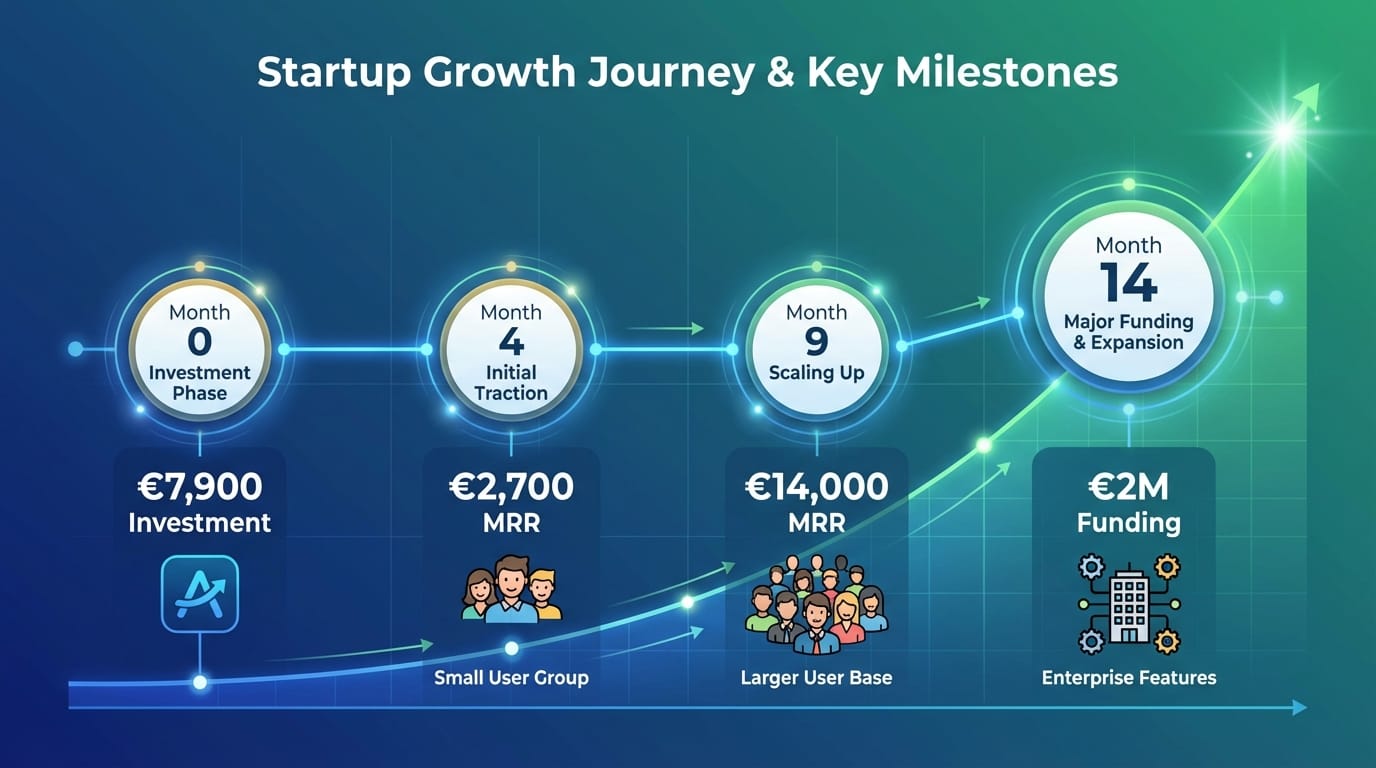
They launched with 12 beta users from their network. By month four, they had 180 paying customers at €15/month. The app handled it fine.
Here's what broke: the Google Sheet workflow. At 50 bookings per day, manual reconciliation became impossible. We spent €2,400 building a basic admin panel. Took four days because the data layer was already clean.
Revenue at this stage: €2,700 MRR. Churn was high (22%) but they were learning fast. The biggest request? Multi-location support. We added it in eight days by extending the existing service model—no database migration, no refactoring.
This is where most MVPs collapse. You add features by bolting on workarounds until the codebase is spaghetti. Then you face the "rebuild or die" moment. We avoided it because the Flutter architecture separated concerns properly. The booking logic didn't know about locations. Adding them was configuration, not surgery.
Month 9: The Scaling Test
A competitor shut down and 3,000 users migrated in two weeks. The app didn't crash.
What we did in week two of the original build: set up Firebase for authentication and Firestore for data. Firestore scales automatically. When usage spiked, Google's infrastructure handled it. We didn't write scaling code—we chose infrastructure that scales by default.
The backend was a handful of Cloud Functions. At 50,000 requests/day, our bill went from €40 to €180/month. No performance tuning needed. No server provisioning. The founder focused on onboarding the new users instead of firefighting infrastructure.
By month nine: €14,000 MRR, 4,200 active customers, 8% churn. They hired their first employee—a customer success person, not a developer.
Month 14: The Features That Justified Fundraising
Investors don't fund MVPs. They fund traction plus credible expansion plans.
The founder raised €2M on this story: proven product-market fit (metrics), multi-location capability (already built), and a roadmap showing enterprise features (team management, analytics, API access). Two of those three existed because our MVP architecture made them cheap to add.
We built the analytics dashboard in three weeks using the existing data models. No ETL pipeline, no data warehouse—just aggregation queries on Firestore with caching. Good enough for 95% of customers and impressive enough for investor demos.
The API took two weeks because we'd structured everything as services from the start. Exposing endpoints was mostly authentication and rate limiting. A monolithic MVP would have needed months of refactoring first.
At Etere Studio, we've seen the pattern repeatedly: investors want proof you can execute fast. Showing them features you built in weeks, not months, is more convincing than pitch deck promises.
What Actually Enabled Scaling
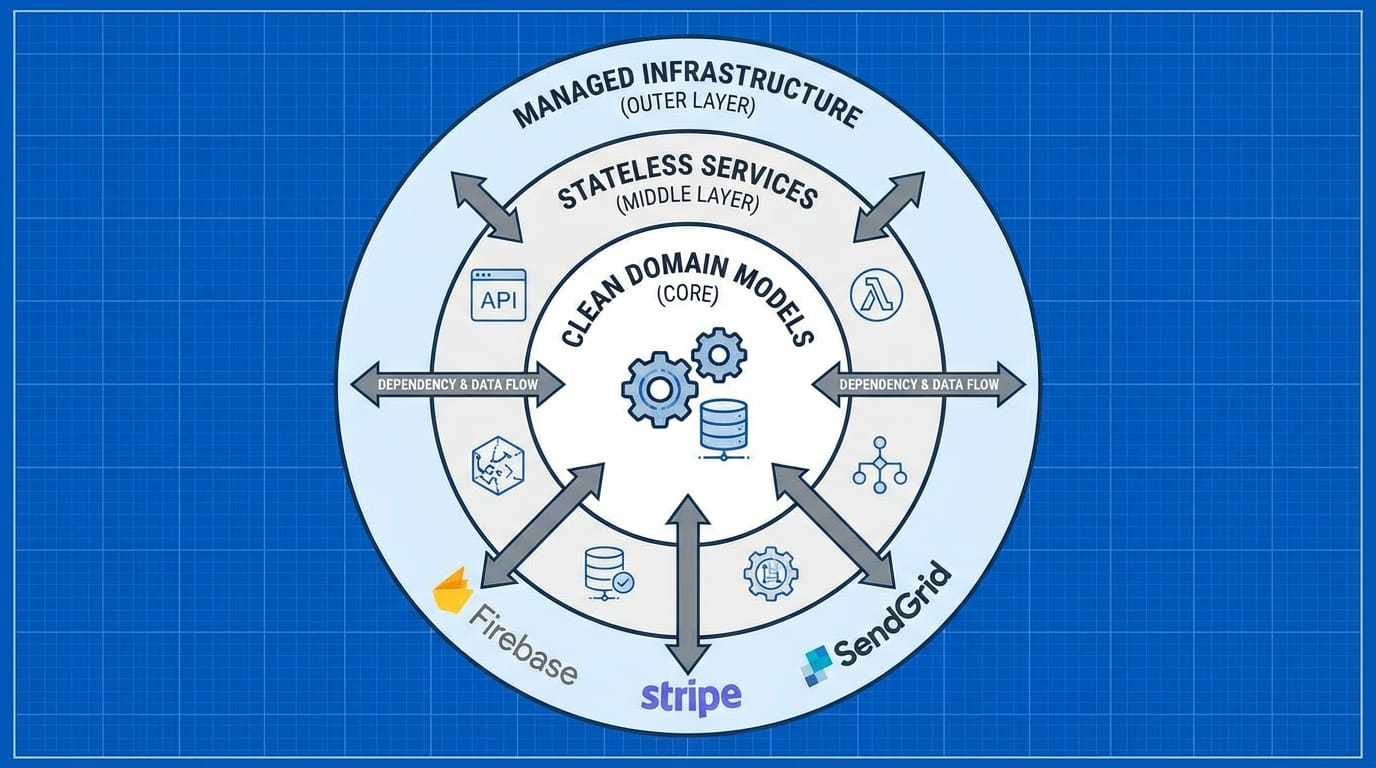
Not Flutter specifically—though hot reload and single codebase helped. Three architectural decisions:
1. Stateless services from day one. Every feature was a pure function: input → output. No hidden dependencies. When we needed to scale horizontally, we just... did. No refactoring required.
2. Managed infrastructure. Firebase, Stripe, SendGrid, Vercel. We paid slightly more per user but saved weeks of DevOps. At MVP stage, your bottleneck is feature velocity, not hosting costs.
3. Clean data models. We spent four hours in week one sketching domain objects. Boring work. But when they wanted team accounts, those models extended cleanly. No migration hell.
The technical choices mattered, but the strategic one mattered more: we built for the next two features, not the next twenty. When you're pre-revenue, you don't know what features you'll need. You do know you'll need to add them fast.
The Challenges Nobody Mentions
This wasn't smooth. At month six, they almost ran out of money. At month eight, a critical bug took down payments for six hours. At month twelve, they lost their biggest customer (15% of MRR) to a enterprise competitor.
The Flutter codebase didn't save them from those problems. But it did let them focus energy on solving customer problems instead of fighting technical debt. When that big customer left, they built enterprise features in four weeks to win them back. They succeeded because the architecture let them move fast.
Honestly, most MVPs don't scale like this. Usually you rebuild around month eighteen when you understand the product better. But when founders ask us "Can this MVP actually grow?" we can point to this case and say: yes, if you make the right calls early.
When to Start With an MVP vs Full Build
Choose the 3-Week App approach when:
- You're pre-revenue and need to validate demand fast
- Your core value is the business model, not novel technology
- You can define three screens that prove the concept
- You have budget for iteration (€2-5K per feature later)
Go straight to full build when:
- You have committed customers or contracts pre-launch
- The tech itself is the differentiator (complex algorithms, real-time sync)
- Regulatory or security requirements demand extensive infrastructure
- You're experienced enough to spec features accurately
The founder in this story chose right because they had an unvalidated idea and limited capital. The €7,900 MVP let them learn without betting the company. When it worked, the architecture let them scale without starting over.
At eighteen months: 50,000 MAU, €84,000 MRR, €2M raised, five employees. Built on the same codebase we delivered in week three.
The Real Lesson
You don't need a perfect product on day one. You need a foundation that doesn't punish you for being wrong about features.
Most MVP advice focuses on cutting features. That's table stakes. The harder question is: what architecture lets you add features fast when you figure out what users actually want?
For this founder, the answer was Flutter with Firebase, clean separation of concerns, and managed services. For your project, it might be different. But the principle holds: build the minimum that validates your idea, using patterns that won't collapse when you scale.
Building something similar and want to talk through your MVP strategy? We're happy to share what we've learned from dozens of projects. Get in touch.