
MVP Feature Prioritization: A Framework for Startup Founders (With Real Examples of What We Cut)
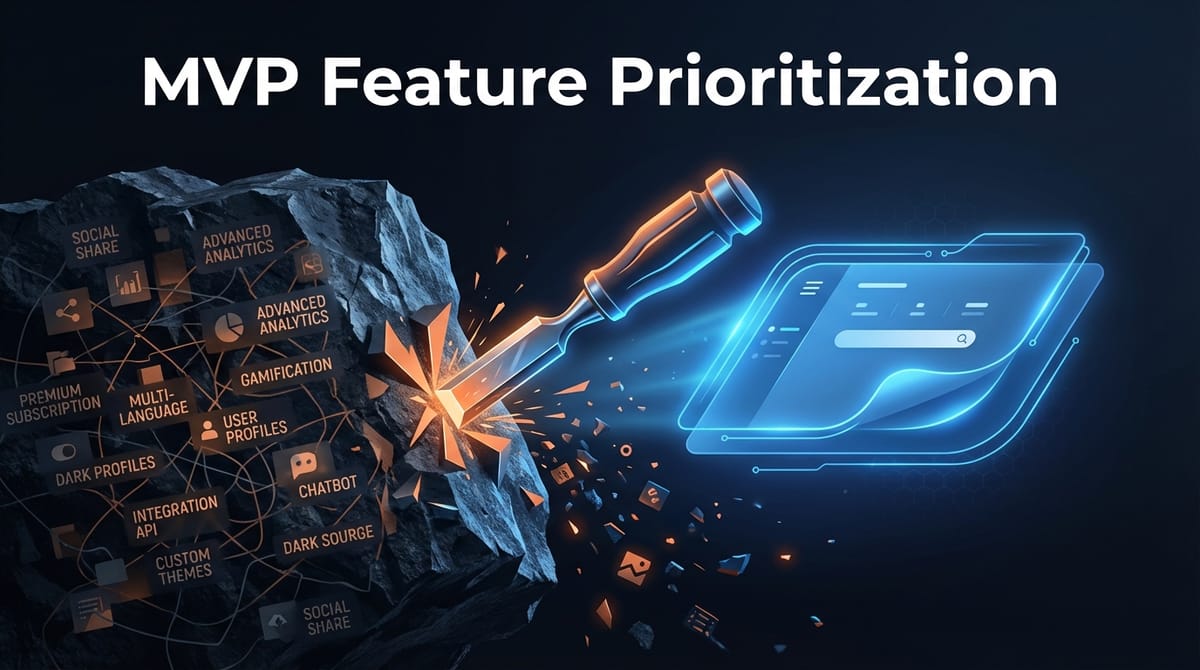
Most MVPs fail not because they have too few features, but because they have too many. After building MVPs for startups across Europe and the US, we've seen the same pattern: founders add features "just in case," timelines stretch from 8 weeks to 6 months, and by launch, the market has moved on.
The fix isn't complicated. It's a framework we use at Etere Studio for every project—and a willingness to say no to features that feel essential but aren't.
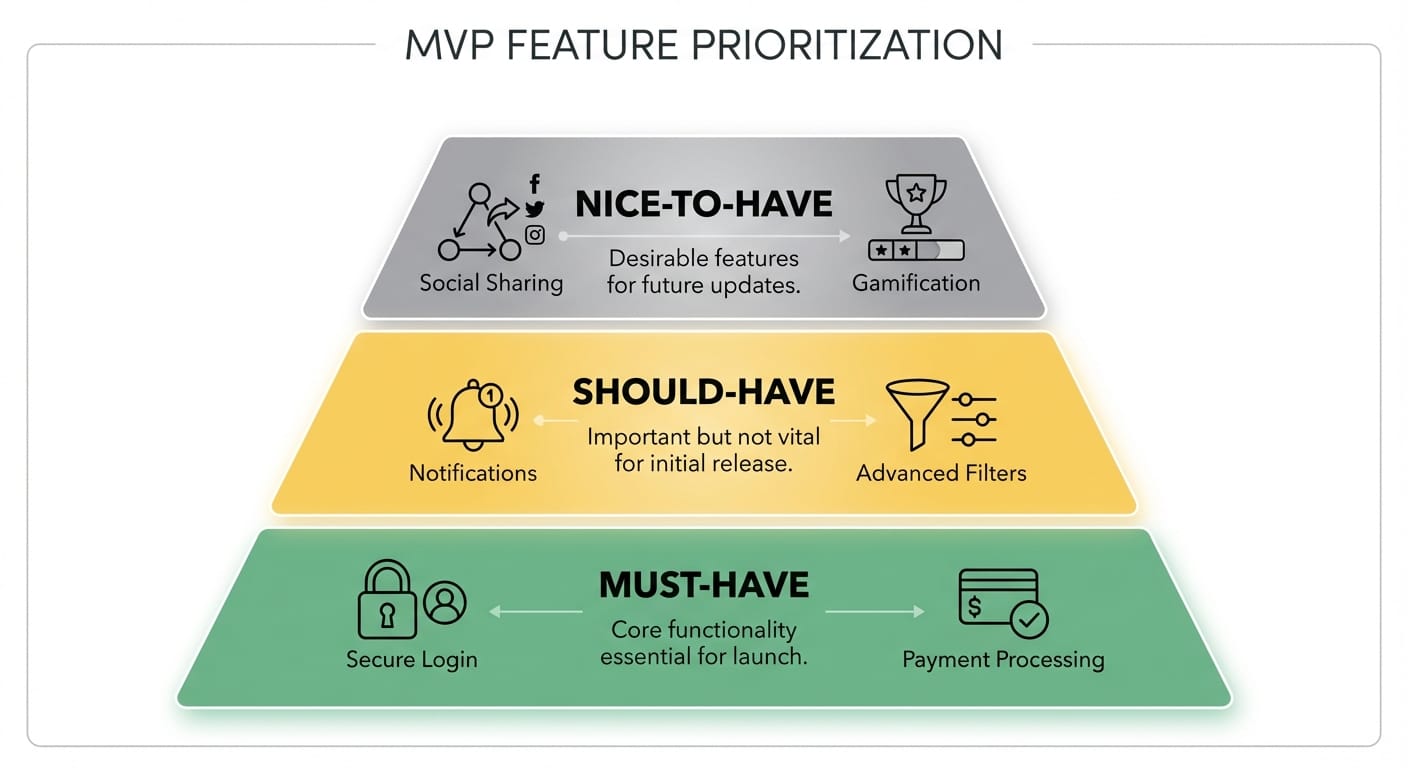
The 3-Tier Prioritization Framework
Every feature request goes into one of three buckets. No exceptions, no "it's kind of both" compromises.
Tier 1: Must-Have
Without these, your product doesn't work. Not "works worse"—doesn't work at all. For a food delivery app, that's ordering and payment. For a marketplace, it's listing and buying. If you remove a Tier 1 feature and the core use case breaks, it stays.
Tier 2: Should-Have
These improve the experience significantly but aren't blockers. Users can complete the core task without them. Push notifications, search filters, user profiles with avatars. Important for retention, not for launch.
Tier 3: Nice-to-Have
Features that sound good in planning meetings but won't affect your first 100 users. Social sharing, gamification, advanced analytics dashboards. These belong in version 2.0—or never.
The hard part isn't understanding the tiers. It's being honest about which tier each feature actually belongs in.
Red Flags That a Feature Shouldn't Be in Your MVP
After dozens of MVP projects, we've learned to spot features that seem critical but almost never are. Here's what triggers our "let's talk about this" conversation:
"Our competitors have it." Feature parity is a trap. Your competitors built those features after validating demand with thousands of users. You're building for your first 50. Different game, different rules.
"We'll need it when we scale." You're not scaling yet. Building for 100,000 users when you have zero is like buying a warehouse before your first sale. Optimize for learning, not load.
"Users will expect it." Maybe. But have you asked them? Most assumptions about user expectations come from founders projecting their own preferences. Real users are more forgiving than you think—if your core value is strong.
"It's only a few days of work." It never is. Every feature adds testing, edge cases, maintenance, and cognitive load. A "small" feature that takes 3 days to build might take 3 weeks to get right.
"What if someone asks for it?" Then you'll know there's demand. Building features before anyone asks is guessing. Building after someone asks is responding to real signal.
Real Examples: Features We Cut (And What Happened)
These are anonymized, but the conversations were real.
The Admin Dashboard That Never Got Used
A B2B SaaS client insisted on a full admin dashboard: user management, analytics, role permissions, activity logs. "We need to see what's happening," they said. Two weeks of development time.
We pushed back. For launch, we set up a simple Metabase dashboard connected to their database. Took half a day. Six months post-launch, with 200+ paying customers, they still use Metabase. The custom admin dashboard? Never built. Never needed.
What we learned: Admin tools feel urgent because founders want control. But off-the-shelf solutions work fine until you have real admin problems—which takes longer than you think.
Social Login for a Niche B2B Tool
Another client wanted Google, Apple, and LinkedIn login. "Everyone expects social login," they argued. We looked at their target user: procurement managers at manufacturing companies. These users log in from work computers with corporate email. They don't want social login—they want SSO with their company's identity provider.
We launched with email/password only. Added SSO three months later when enterprise clients actually requested it. Social login? Still not implemented. Zero complaints.
What we learned: "Everyone expects it" usually means "I expect it." Your users might be different from you.
Push Notifications for a Weekly-Use App
A wellness app client wanted push notifications from day one. Reminders, streaks, achievements, the works. The app was designed for weekly check-ins—not daily engagement.
We launched without push. Used email for the weekly reminder instead. Open rates: 45%. When they eventually added push notifications, opt-in rate was 12%. Email still drives more engagement.
What we learned: Push notifications are a retention tool, not a launch requirement. And they only work if your app warrants daily attention.
The Offline Mode Nobody Used
A field service app client wanted full offline functionality. "Our technicians work in basements with no signal," they explained. Offline mode would have added 4-6 weeks to the timeline.
We suggested launching without it and tracking how often sync failures occurred. Result: 3% of sessions had connectivity issues, and technicians just waited until they had signal. The business impact? Negligible. They never built offline mode.
What we learned: Edge cases feel important in planning. Data tells you if they actually are.
The Three Mistakes Founders Keep Making
Mistake 1: Building for Scale Before You Have Users
We see this constantly. Founders want microservices architecture, Kubernetes, multi-region deployment—for an app with zero users. The technical complexity adds months to development and makes iteration slower.
Here's the truth: a well-built monolith handles thousands of concurrent users. By the time you need to scale, you'll have revenue to fund the refactoring. Build for today's problems, not imaginary future ones.
Mistake 2: Matching Competitor Features
Your competitor's feature list is a history of their experiments, not a roadmap for yours. They built those features in response to specific user feedback, business needs, and market conditions—none of which apply to you yet.
Focus on what makes you different, not what makes you the same. One exceptional feature beats ten mediocre ones.
Mistake 3: Solving Problems You Assume Exist
The most expensive features are the ones that solve problems users don't actually have. Before building anything, ask: "What evidence do we have that this is a real problem?" If the answer is "it makes sense" or "I would want it," that's not evidence. That's a hypothesis.
Talk to users. Look at behavior data. Wait for requests. The best MVP features come from observation, not imagination.
Your MVP Prioritization Checklist
Before any feature makes it into your MVP, run it through these questions:
The Core Test
- Does the product work without this feature? If yes, it's not Tier 1.
- Can users complete the main job-to-be-done without it? If yes, it's Tier 2 or 3.
The Evidence Test
- Have real users (not friends/family) asked for this? If no, question it.
- Do you have data suggesting this is a problem? If no, wait for data.
The Timing Test
- Does this need to exist at launch, or after you have users? Most features can wait.
- Are you building this because of current needs or future assumptions? Assumptions can wait.
The Effort Test
- What's the real development time, including testing and edge cases? Multiply your estimate by 2.
- Is there a simpler version that validates the same hypothesis? Build that instead.
The Alternative Test
- Can this be solved with an existing tool (Zapier, Airtable, manual process)? If yes, use that first.
- Can you fake it until you have validation? Manual processes are fine for early users.
If a feature fails more than one of these tests, it doesn't belong in your MVP. Put it on the "after launch" list and move on.
The Uncomfortable Truth About MVP Scope
Every feature you add to your MVP is a bet. You're betting development time, launch delays, and complexity against the chance that users will care. Most bets lose.
The founders who ship successful MVPs aren't the ones with the best ideas—they're the ones willing to cut the most. They launch embarrassingly simple products, learn what users actually want, and build from there.
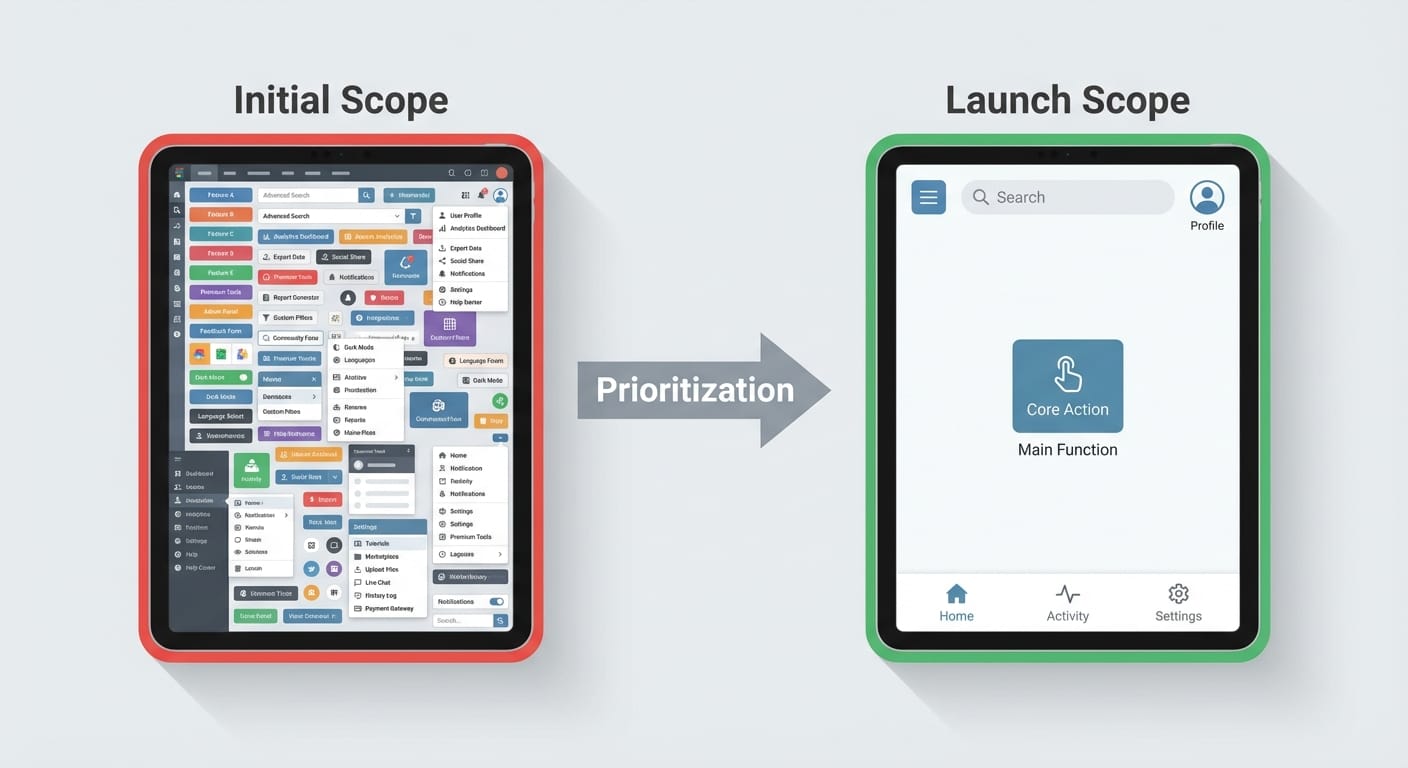
At Etere Studio, we've helped teams cut their MVP scope by 40-60% without losing anything that mattered. The result: faster launches, lower costs, and products that evolved based on real feedback instead of assumptions.
Your MVP doesn't need to be impressive. It needs to be live.
Stuck on what to cut from your MVP? We've had this conversation with dozens of founders. Let's talk through your feature list—sometimes an outside perspective is all it takes.