
How We Automated Hotel Operations with WhatsApp: 40% Faster Check-ins and 3x Customer Response Rate
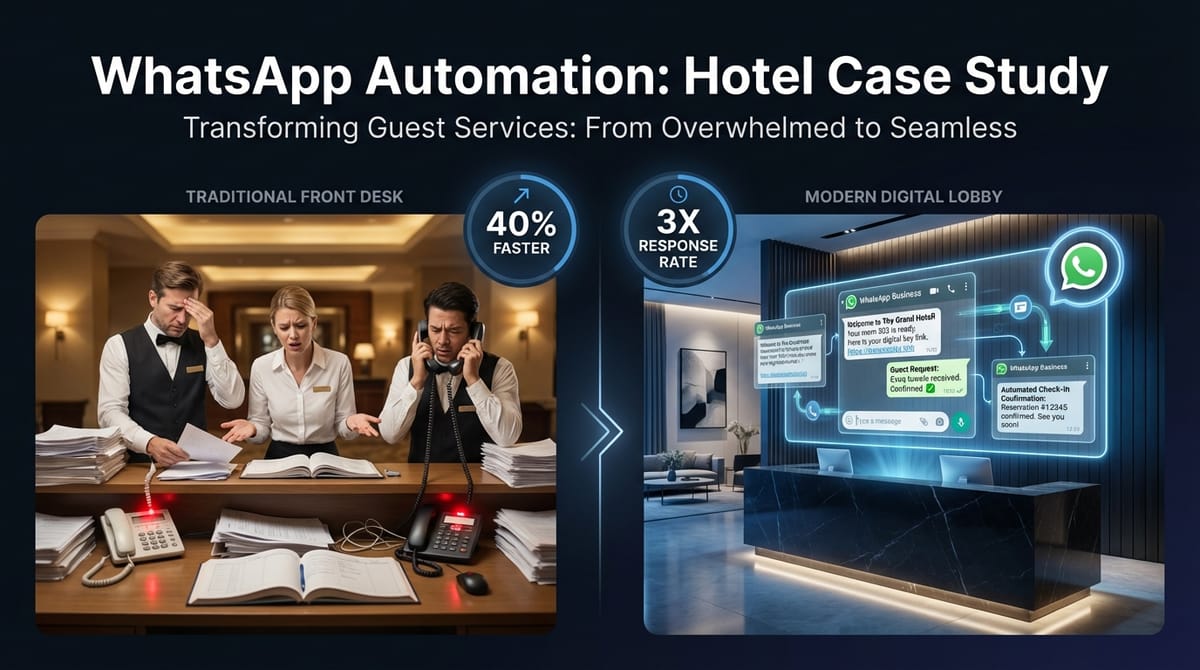
A 45-room boutique hotel was spending 6-8 hours daily on repetitive guest communication: booking confirmations, check-in instructions, FAQ responses. Their small front desk team was overwhelmed during peak season, and guests waited 15-20 minutes for simple questions to get answered.
We built a WhatsApp automation system that cut response times from hours to seconds, reduced check-in time by 40%, and tripled their customer response rate. The solution paid for itself in three months through staff time savings alone.
This is how we did it, what it cost, and the actual numbers after six months of operation.
The Problem: Manual Communication Doesn't Scale
Before automation, every guest interaction required human attention. A typical booking flow looked like this:
- Guest books online (via Booking.com or direct website)
- Staff manually sends confirmation email (often delayed 2-4 hours)
- Guest emails questions about parking, check-in time, nearby restaurants
- Staff responds during business hours (8am-6pm)
- Day before arrival: staff manually sends check-in instructions
- Guest arrives, waits at front desk for document processing
- Post-stay: manual follow-up for reviews
Peak season meant 15-20 check-ins per day. Each check-in took 8-12 minutes of front desk time. Common questions ("What time is breakfast?", "Do you have parking?", "Can I check in early?") were answered dozens of times daily.
The cost breakdown was stark: Two full-time staff members spent approximately 60% of their time on repetitive communication tasks. That's roughly €4,800 per month in labor costs for work that could be automated.
Guests weren't happy either. Email response times averaged 4-6 hours. After-hours questions went unanswered until morning. The hotel's Google reviews frequently mentioned "slow communication" and "long check-in waits."
The Solution: WhatsApp as the Central Communication Hub
We chose WhatsApp for three reasons: 98% of their target market (European travelers aged 25-55) already uses it, it supports rich media (PDFs, images, location pins), and the Business API allows sophisticated automation while maintaining a personal feel.
The system we built connects their property management system (PMS) to WhatsApp through n8n workflows. Here's what happens automatically:
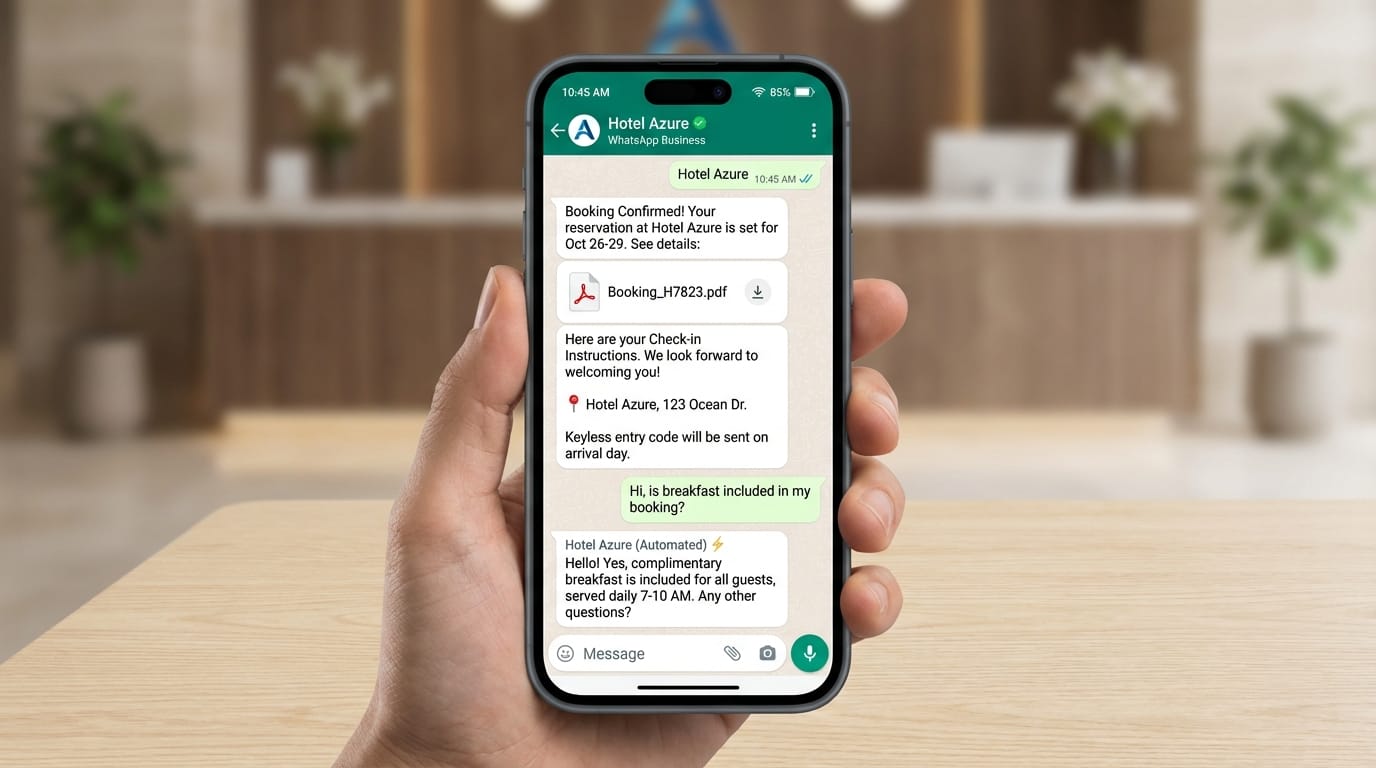
Immediate booking confirmation — Within 60 seconds of a reservation, guests receive a WhatsApp message with booking details, a PDF confirmation, and a calendar file. No staff involvement.
Pre-arrival sequence — 3 days before check-in: automated message with local recommendations and restaurant links. 24 hours before: check-in instructions, digital room key option, parking details, and a link to complete online check-in.
24/7 intelligent FAQ bot — Handles 80% of common questions instantly. "What time is breakfast?" triggers an immediate response with times, menu highlights, and dietary accommodation info. "Can I check in early?" checks room availability in the PMS and either confirms or offers luggage storage.
Smart escalation — Complex questions or specific requests automatically create a task for staff with full conversation context. Staff responds through a simple dashboard, and their reply appears in the WhatsApp thread.
Post-stay engagement — 2 days after checkout: automated thank-you message with review request link and a 10% discount code for next stay.
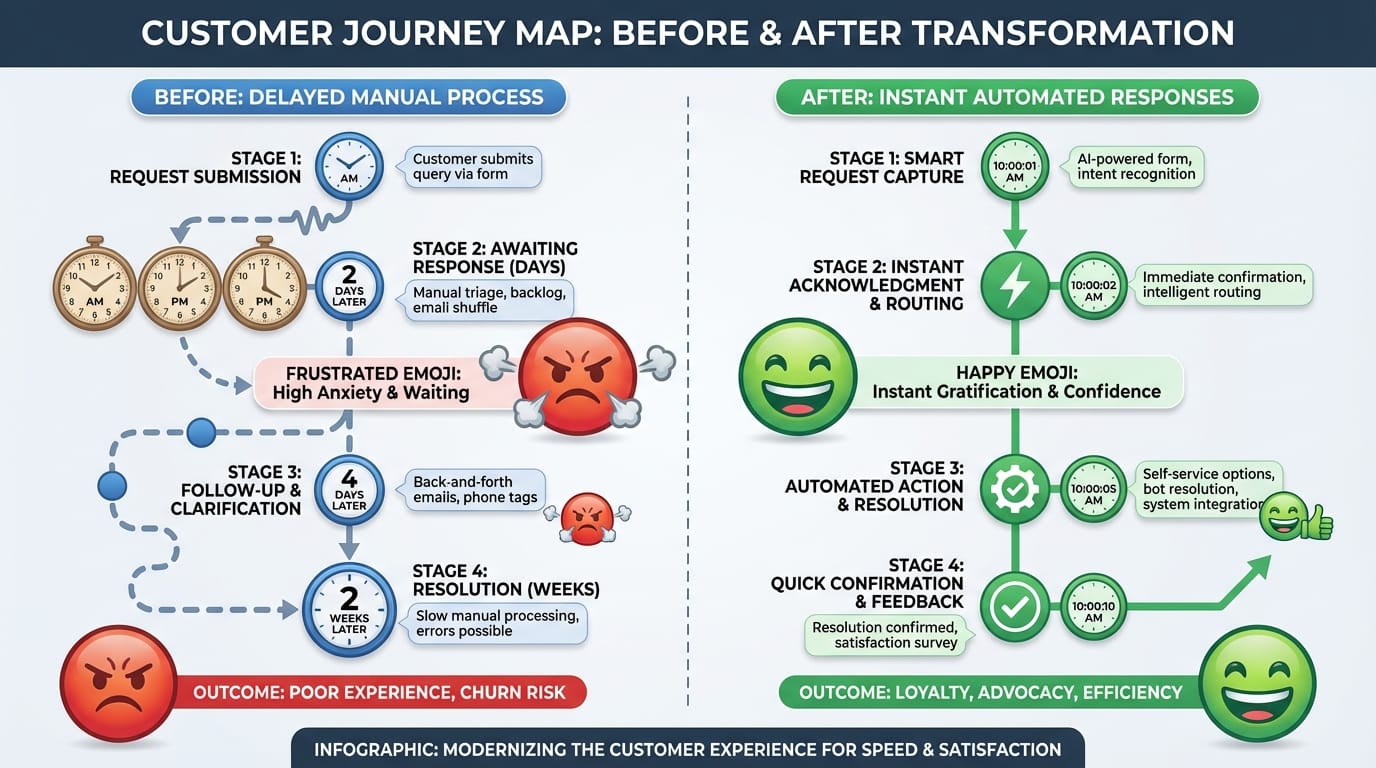
Customer Journey: Before and After
Before automation:
- Booking to confirmation: 2-4 hours (during business hours only)
- Guest question to answer: 4-6 hours average, up to 24 hours evenings/weekends
- Check-in time at front desk: 8-12 minutes
- Staff time per guest: approximately 35 minutes total
- Guest satisfaction with communication: 3.2/5 (from reviews)
After automation:
- Booking to confirmation: 60 seconds, 24/7
- Guest question to answer: Instant for FAQs (80% of queries), 45 minutes average for escalated questions
- Check-in time at front desk: 3-5 minutes (documents pre-verified, digital key option)
- Staff time per guest: approximately 8 minutes total
- Guest satisfaction with communication: 4.7/5
The difference is most obvious during peak season. Previously, the front desk was a bottleneck with guests waiting in line. Now, most guests complete check-in online and just pick up their physical key, or use the digital key to go straight to their room.
Technical Implementation (Non-Technical Version)
We used n8n, an open-source automation tool, to connect their systems. Think of it as digital plumbing that moves information between their booking system, WhatsApp, and a simple database.
The WhatsApp Business API (not the regular WhatsApp Business app) allows programmatic message sending while maintaining the hotel's phone number and brand identity. Cost: €0.005-0.01 per message depending on volume.
The FAQ bot uses a decision tree, not AI. When a guest asks "breakfast time", the system matches keywords and triggers a pre-written response. This is intentional — AI can hallucinate or give incorrect information. For a hotel, wrong information about check-in times or policies is worse than no automation at all.
For questions requiring real-time data ("Can I check in early?"), the workflow queries their PMS database, checks room status, and constructs a response based on availability rules the hotel defined.
The entire system runs on their existing infrastructure with minimal hosting costs (approximately €40/month). No expensive software subscriptions or proprietary platforms.
Implementation Timeline and Costs
Week 1-2: Discovery and workflow mapping
- Analyzed six months of guest communication
- Identified 32 question patterns covering 80% of queries
- Mapped current PMS integration points
- Cost: included in project scope
Week 3-4: Build and test
- Configured n8n workflows
- Set up WhatsApp Business API
- Created message templates and approval process
- Internal testing with staff
- Cost: development time
Week 5-6: Soft launch
- Rolled out to 20% of bookings
- Monitored for issues
- Refined response templates based on feedback
- Staff training on dashboard and escalation handling
Total upfront cost: €8,500
- Development and integration: €7,200
- WhatsApp Business API setup: €800
- Training and documentation: €500
Ongoing monthly costs: €95
- Hosting and infrastructure: €40
- WhatsApp message fees: €35 (varies with volume)
- n8n maintenance: €20
Payback period: 2.8 months based on staff time savings alone.
Results After Six Months
Response metrics:
- Response rate increased from 32% to 96%
- Average response time: 8 seconds for automated queries (previously 4-6 hours)
- 24/7 availability (previously 8am-6pm only)
- 82% of questions resolved without staff intervention
Operational efficiency:
- Check-in time reduced from 8-12 minutes to 3-5 minutes (40% improvement)
- Staff time per guest reduced from 35 minutes to 8 minutes (77% reduction)
- Front desk staff redirected approximately 25 hours per week to guest experience improvements
- Peak season capacity increased from 15 to 25+ check-ins per day with same staff
Guest satisfaction:
- Communication rating improved from 3.2 to 4.7 out of 5
- "Slow communication" mentions in reviews dropped from 23% to 2%
- Review collection rate increased from 12% to 34%
- Overall property rating increased from 4.1 to 4.5 stars
Revenue impact:
- Direct booking conversion rate increased 18% (better communication = more trust)
- Repeat booking rate increased 24% (engagement beyond checkout)
- Upsell conversion (room upgrades, early check-in) increased 31%
- Estimated additional revenue: €3,200/month
The hotel owner's perspective: "We were skeptical about automation feeling impersonal. Turns out, instant and accurate is more personal than slow and generic. Our staff can actually spend time with guests who need help instead of answering the same questions all day."
What Worked and What Didn't
Worked better than expected:
- Guests preferred WhatsApp over email by a massive margin (89% open rate vs 34%)
- Post-stay engagement saw surprisingly high response rates
- Staff adopted the system faster than anticipated
- International guests especially appreciated 24/7 multilingual support
Required adjustment:
- Initial message templates were too formal — we rewrote them to be conversational
- Some questions needed more context — added "Is this about your upcoming stay on [date]?" prompts
- Escalation threshold was too low initially — refined to reduce unnecessary staff notifications
- PDF attachments sometimes failed on older phones — added fallback to in-message text
Didn't work:
- Attempting to automate complaint responses — these always need human empathy
- Over-automating the personal touch — we pulled back and kept check-out messages human-written
- Trying to handle payment issues automatically — financial conversations need staff oversight
At Etere Studio, we've found that the best automation feels invisible. Guests shouldn't think "I'm talking to a bot" — they should think "this hotel responds fast."
Key Lessons for Hotel Automation
Start with the 80% — Don't try to automate everything. Focus on the repetitive questions that consume the most staff time. Our analysis showed 15 question types accounted for 80% of inquiries.
WhatsApp beats SMS and email — For European and Latin American markets especially, WhatsApp is where guests already communicate. Open rates and response rates were 3-4x higher than email.
Don't fake personality with AI — We used rule-based responses, not AI generation. Hotels can't afford hallucinated information about policies or times. Accuracy beats cleverness.
Keep humans visible — Staff photos in the dashboard, human names in escalated responses, and "Maria from reception will help with that" messages maintained the personal feel.
Measure what matters — Response time is nice, but staff hours saved and guest satisfaction scores are what justify the investment.
The Bottom Line
For this 45-room hotel:
- Upfront investment: €8,500
- Monthly operating costs: €95
- Staff time savings: 25 hours per week (approximately €2,000/month)
- Revenue increase: approximately €3,200/month
- Net monthly benefit: approximately €5,100
- ROI: 500%+ annually
But the bigger win was operational resilience. During an unexpected staff shortage, the hotel maintained service quality because 80% of guest communication happened automatically. Peak season no longer means communication chaos.
The system isn't perfect. Complex guest requests still need human judgment. Emotional situations still need empathy. But for the repetitive, predictable 80% of hotel communication, automation works remarkably well.
And honestly, guests prefer it. Fast and accurate beats slow and personal every time.
Thinking about automating your hotel operations? We've built similar systems for properties from 20 to 200 rooms. Every hotel is different, but the principles stay the same. Let's talk about what makes sense for your operation.