
The Future of Software Development in 2026: 5 Shifts Every Tech Leader Must Understand
Software development in 2026 looks nothing like it did three years ago. The changes aren't incremental—they're structural. If you're leading a tech team or making build decisions, here's what's actually shifting under your feet.
We're seeing these changes firsthand at Etere Studio, working with startups and mid-size companies across Europe and the US. Some patterns are obvious once you see them. Others sneak up on you. All of them matter.
AI-Assisted Coding Has Changed Development Velocity (And Economics)
GitHub Copilot isn't new anymore. Neither is Cursor or any of the other AI coding assistants. What's new is that they've moved from "interesting toy" to "baseline expectation" in about 18 months.
In our experience, competent developers using AI assistance are 30-40% faster on greenfield projects. Not because AI writes perfect code—it doesn't—but because it handles the boring parts: boilerplate, common patterns, API integrations we've all written a dozen times.
The economics matter here. A senior Flutter developer costs $80-120k in Europe, more in the US. If AI assistance makes that developer 35% more productive, you're not just saving time—you're fundamentally changing project budgets and timelines.
But here's the thing most people miss: AI-assisted coding doesn't reduce the need for senior talent. It amplifies it. Junior developers struggle with AI tools because they can't tell good suggestions from bad ones. Senior developers move faster because they know exactly what to accept and what to rewrite.
We've adjusted our project estimates accordingly. What used to take 8 weeks now takes 5-6, but only with experienced engineers who know how to direct the AI effectively.
The Low-Code vs Custom Development Decision Has Gotten Clearer
Low-code and no-code platforms have matured significantly. Bubble, Webflow, FlutterFlow—they're legitimately good for certain use cases. The decision framework is pretty straightforward now.
Choose low-code when:
- You're validating a concept, not building a moat
- Your users are internal or you control the full experience
- Standard workflows cover 80%+ of your needs
- You need something this month, not next quarter
Choose custom development when:
- Performance matters (real-time features, heavy data processing)
- You need platform-specific capabilities (camera, Bluetooth, background processing)
- Your differentiation is in the product itself
- You're building for scale and longevity
The gap between low-code and custom has actually widened in some ways. Low-code got better at rapid prototyping. Custom development got faster with AI assistance and better frameworks. The middle ground—starting low-code then migrating to custom—remains expensive and painful.
We recommend low-code to about 20% of the companies that contact us. Usually early-stage startups testing product-market fit. For the other 80%, the flexibility and ownership of custom code is worth the investment.
Waterfall Is Actually Dead Now (And What Replaced It)
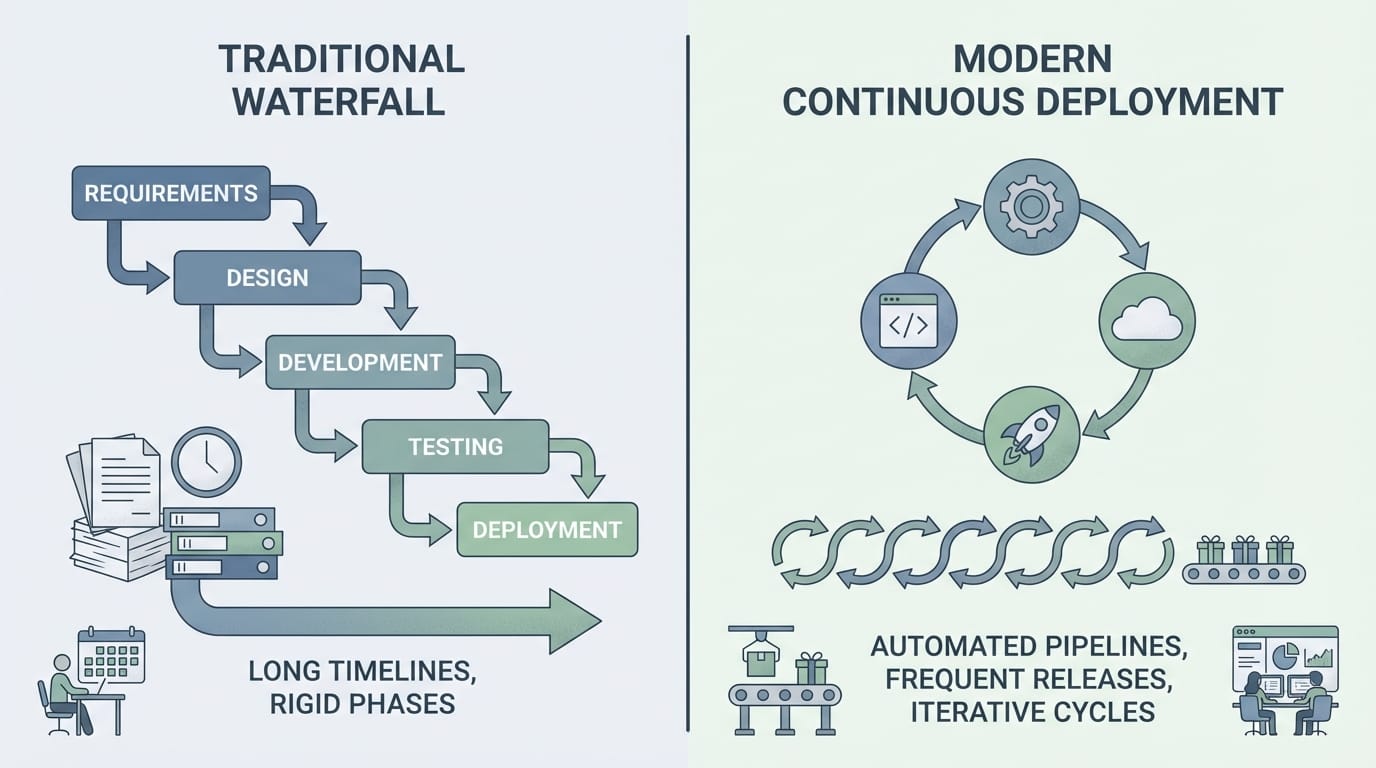
Waterfall was already unfashionable in 2020. By 2026, it's extinct in modern software companies. Not because of ideology, but because it can't keep up.
Continuous deployment isn't just about technical capability anymore—it's about organizational culture. Companies that ship daily have a fundamentally different relationship with risk than companies that ship quarterly.
At Etere Studio, every client project includes CI/CD from day one. Not because it's technically difficult (it isn't), but because it forces better practices:
- Automated testing becomes non-negotiable
- Feature flags let you deploy without launching
- Rollback is trivial, so experiments are cheap
- Feedback cycles collapse from weeks to days
The teams we work with that struggle most are the ones coming from traditional release cycles. They want to "finish" features. But finished is a moving target when you're shipping continuously. You deploy the MVP, watch user behavior, iterate.
This shift requires trust. Trust that your tests catch problems. Trust that your monitoring alerts you quickly. Trust that small changes are safer than big releases. Most teams underestimate how much organizational change this requires.
Remote-First Development Teams Are the New Default
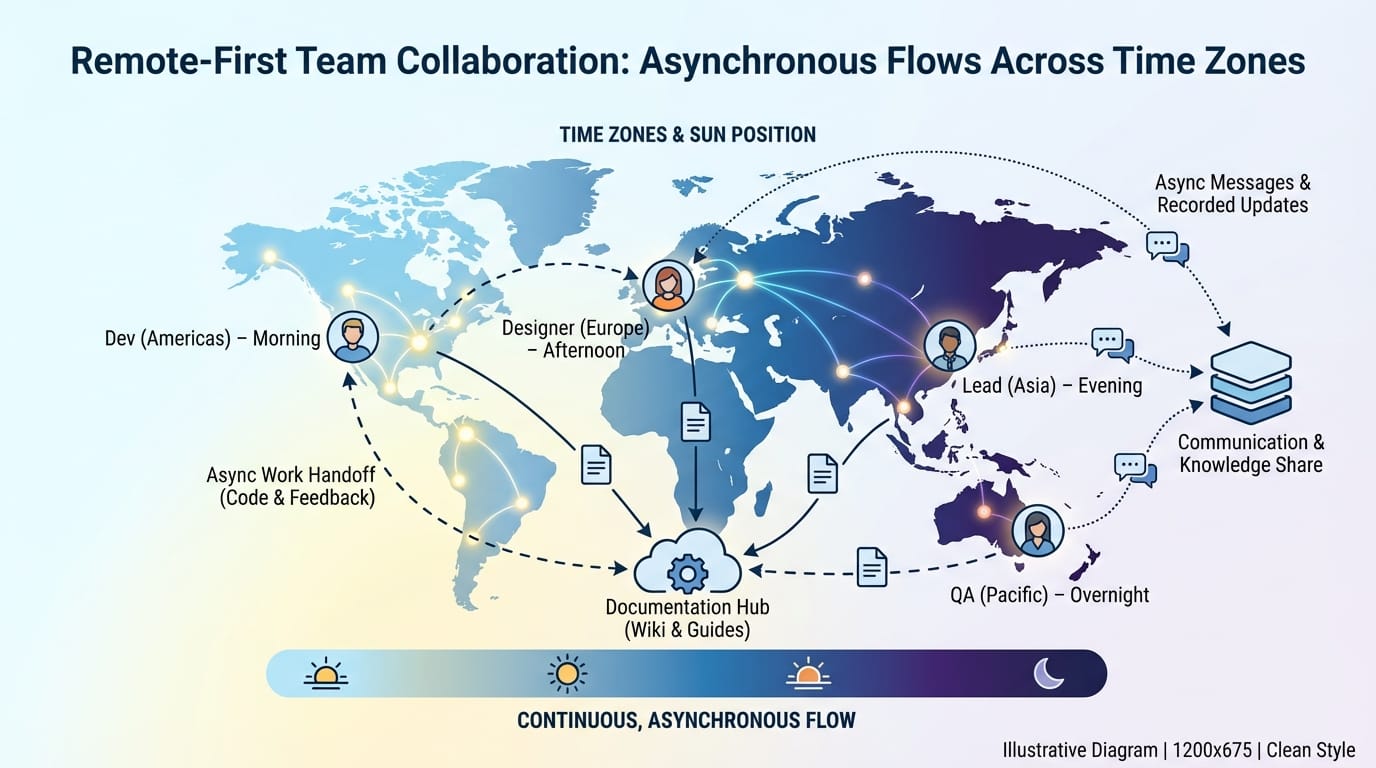
Remote work for developers isn't experimental anymore. It's the baseline. But remote-first (as opposed to remote-allowed) requires different practices.
Remote-first means:
- Documentation isn't optional. If it's not written down, it doesn't exist.
- Async communication is primary. Meetings are the exception.
- Time zones are a feature, not a bug. Someone's always working.
- Onboarding is systematic, not osmotic.
We're a small team, but we're distributed across three time zones. This works because we've built practices around it:
- All technical decisions documented in ADRs (Architecture Decision Records)
- Code review is async with clear SLAs (24 hours max)
- Weekly check-ins, but all status updates are written
- Pair programming sessions scheduled, never spontaneous
The companies hiring us for development work increasingly care less about location than capability. They want senior Flutter engineers who can ship. Whether those engineers are in Berlin or Bucharest matters less than whether they can communicate clearly and work independently.
Actually, remote-first development has made hiring both easier and harder. Easier because the talent pool is global. Harder because remote requires higher baseline competence—there's no senior developer looking over your shoulder to catch mistakes.
Future-Proof Skills: What Developers Actually Need
The skills that matter in 2026 aren't the ones most bootcamps teach. Coding ability is table stakes. The differentiation comes from:
AI collaboration — Not just using Copilot, but directing it effectively. Knowing when to trust suggestions and when to ignore them. Understanding the boundaries of what AI can and can't do.
System thinking — Understanding how pieces fit together. Database design. API architecture. State management. The fundamentals that don't change when frameworks do.
Communication — Writing clear documentation. Explaining technical tradeoffs. Async collaboration. Remote work amplifies communication skills (or lack thereof).
Business context — Understanding why features matter, not just how to build them. Reading analytics. Talking to users. Making tradeoff decisions.
Platform depth — Jack-of-all-trades developers struggle in 2026. Specialists who deeply understand iOS, Android, or web platforms are more valuable than generalists who superficially know everything.
We've seen this in our hiring. When we need a Flutter developer, we don't look for someone who "knows Flutter." We look for someone who understands mobile platforms deeply, can architect scalable solutions, writes clear documentation, and has experience working with AI coding tools.
The ironic part: AI tools have made deep expertise more valuable, not less. Anyone can generate code now. Not everyone can generate the right code.
What This Means for Tech Leaders
If you're making build decisions in 2026, these shifts compound:
- AI assistance changes timeline estimates (faster, but only with senior talent)
- Platform choice matters more as low-code improves and diverges from custom
- Continuous deployment requires organizational readiness, not just technical setup
- Remote-first means investing in documentation and async processes
- Developer skills matter more when you can't rely on in-person oversight
Honestly, the biggest mistake we see is treating these as independent changes. They're interconnected. AI-assisted coding works better with continuous deployment. Remote-first requires better documentation, which makes onboarding easier, which makes AI assistance more effective.
Companies that adapt to all five shifts simultaneously are building software faster and cheaper than companies stuck in 2023 practices. The gap is widening.
Evaluating your development approach for 2026? We can help. Let's talk.