
Flutter vs Native Development in Europe 2026: A Data-Driven Guide for CTOs
European startups face a brutal equation: build fast enough to validate product-market fit, but don't blow your runway on engineering costs. The tech stack choice matters more than most founders realize.
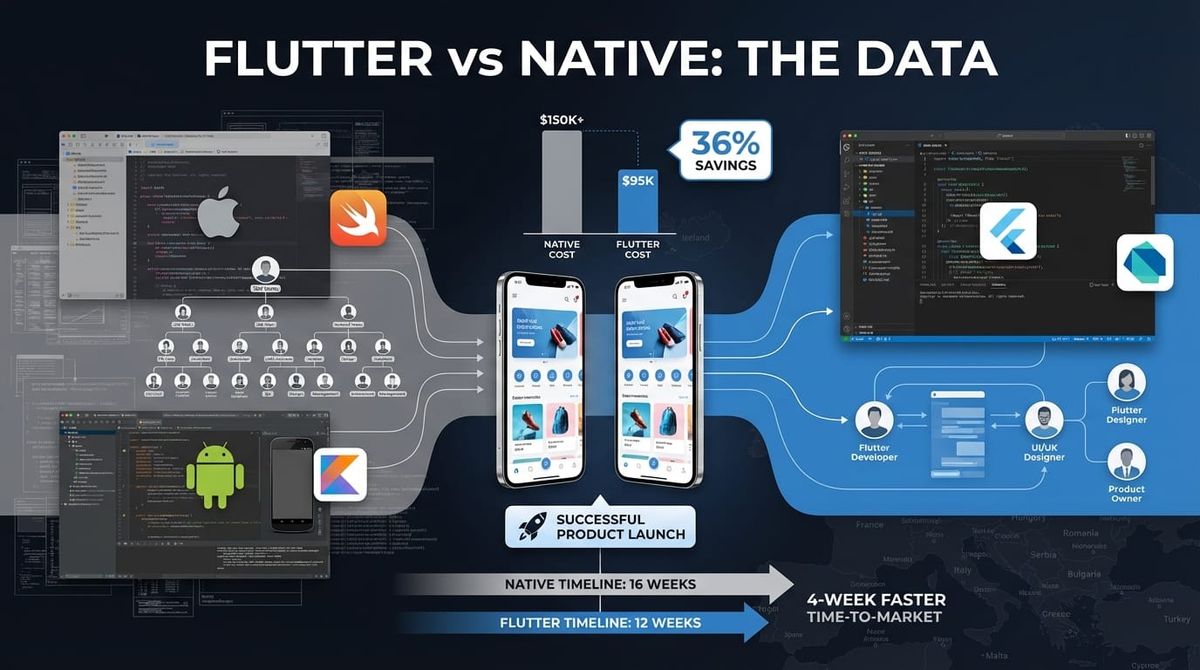
The numbers tell a clear story. A mid-sized Flutter app typically costs €80,000-120,000 to build and launch across iOS and Android. The same app built natively? €140,000-200,000. That difference of €60,000+ isn't just budget—it's three months of burn rate for a lean team.
But cost alone doesn't determine the right choice. Performance, talent availability, and long-term maintainability all factor in. We've built apps both ways across European markets. Here's what the data actually shows.
The European Talent Reality: Developer Availability and Costs
The developer market in Europe varies significantly by country and specialization. Cross-platform app development talent costs less and scales faster than maintaining separate iOS and Android teams.
Senior Flutter developer rates (2026 EU markets):
- UK: €75-95/hour (London), €55-75/hour (outside London)
- Germany: €70-90/hour (Berlin, Munich), €55-70/hour (other cities)
- France: €65-85/hour (Paris), €50-65/hour (Lyon, Toulouse)
- Spain: €50-70/hour (Barcelona, Madrid)
- Italy: €45-65/hour (Milan, Rome)
Senior native iOS/Android developer rates:
- UK: €85-110/hour (London), €65-85/hour (outside London)
- Germany: €80-100/hour (major cities), €65-80/hour (elsewhere)
- France: €75-95/hour (Paris), €60-75/hour (other cities)
- Spain: €60-80/hour (Barcelona, Madrid)
- Italy: €55-75/hour (Milan, Rome)
The native premium is 15-20% per developer. But that's not the main issue. The real problem is hiring two specialists instead of one.
At Etere Studio, we track time-to-hire across projects. Finding a qualified Flutter developer in major EU markets: 3-5 weeks average. Building a native team (one iOS, one Android specialist): 8-12 weeks. For a startup with a Q2 launch deadline, that timeline difference kills momentum.
Developer supply also matters. LinkedIn data shows roughly 180,000 Flutter developers active in Europe versus 320,000 iOS and 290,000 Android specialists. But you need both iOS and Android for native—Flutter gives you one hire covering both platforms.
Time-to-Market: The European Startup Context
Speed defines survival for European startups. Runway averages 12-18 months post-seed. Most founders have one shot at product-market fit before needing to raise again or shut down.
Typical timeline for a feature-complete MVP (European team):
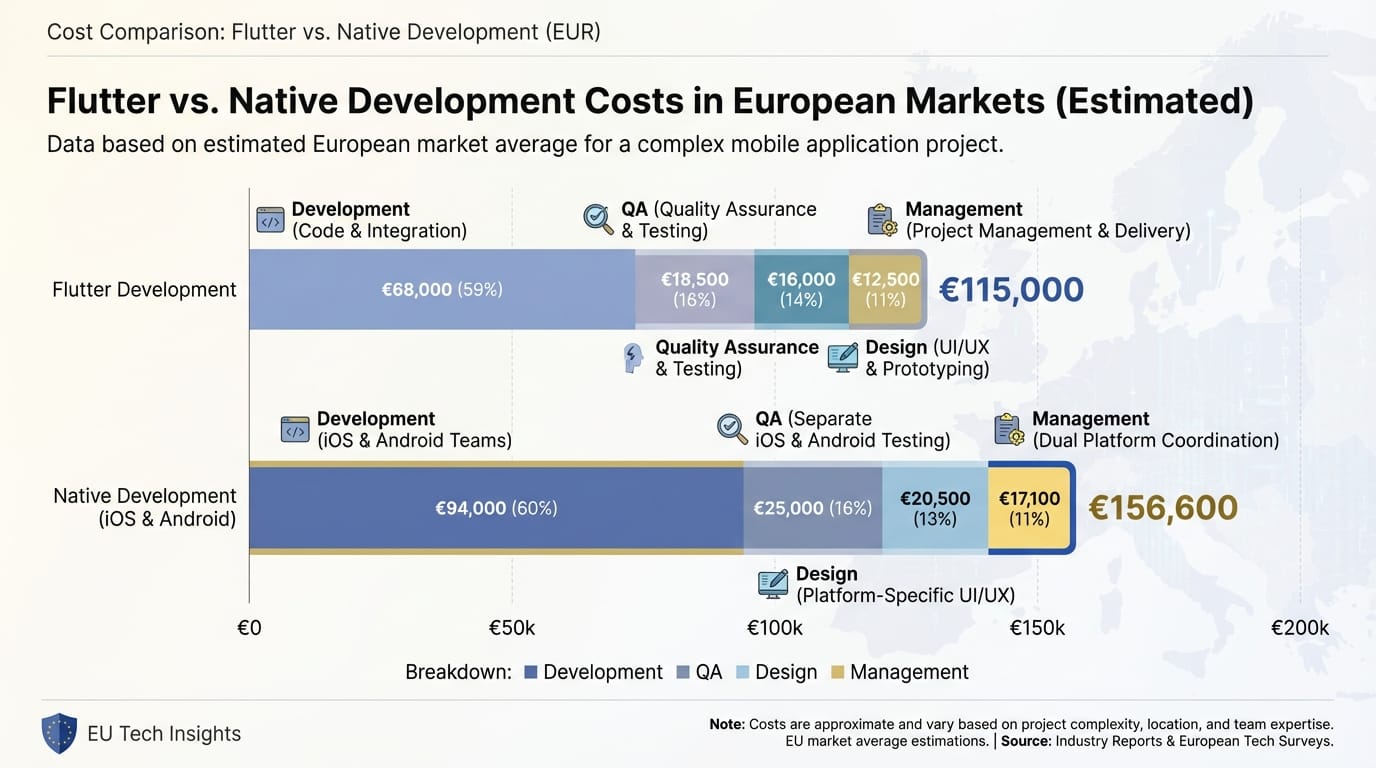
Flutter approach:
- Week 1-2: Architecture and design system setup
- Week 3-10: Core feature development (shared codebase)
- Week 11-12: Platform-specific polish and testing
- Week 13-14: App store submissions and launch prep
- Total: 14 weeks
Native approach:
- Week 1-2: Architecture and design system (iOS)
- Week 3-2: Architecture and design system (Android)
- Week 3-12: iOS development
- Week 3-12: Android development (parallel but never perfectly synced)
- Week 13-16: Cross-platform testing and alignment
- Week 17-18: Dual submissions
- Total: 18 weeks minimum
That four-week difference compounds. In our experience building startup apps across Europe, Flutter projects launch 25-30% faster than native equivalents. One client in Berlin went from concept to 10,000 users in 16 weeks with Flutter. Their competitor chose native and spent 24 weeks just reaching beta.
For consumer apps, those extra weeks matter. Seasonal markets (think fitness apps before summer, finance apps before tax season) have narrow launch windows. Miss it, wait a year.
Cost Breakdown: Real Numbers from European Projects
Let's compare actual startup app development cost for a real project scope: marketplace app with user authentication, real-time chat, payment integration, admin panel. Mid-complexity. Typical seed-stage product.
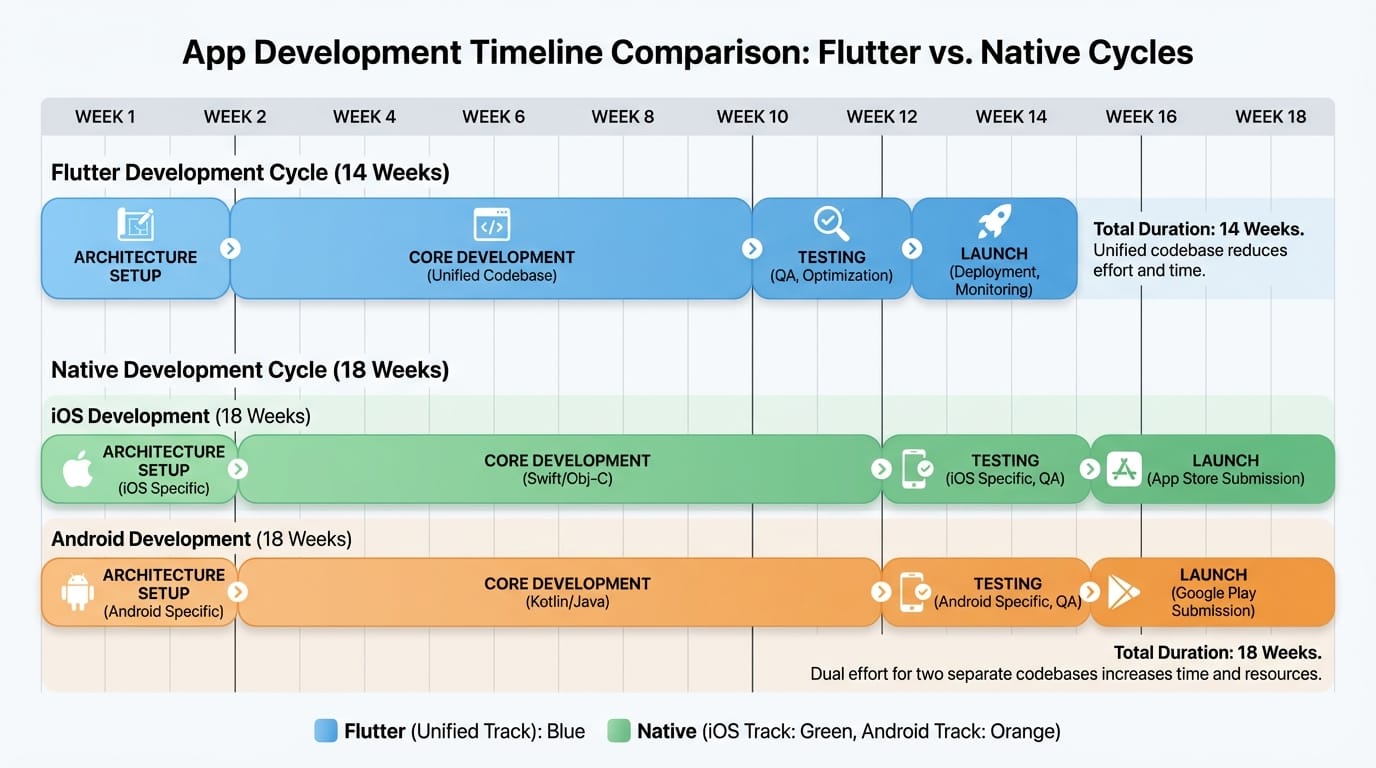
Flutter build (single team, 3 developers, 14 weeks):
- Development: €84,000 (3 devs × €70/hour avg × 14 weeks × 40 hours)
- QA/Testing: €8,400 (shared for both platforms)
- Design: €12,000 (shared components)
- Project management: €7,000
- Infrastructure setup: €3,600
- Total: €115,000
Native build (separate iOS/Android teams, 18 weeks):
- iOS development: €54,000 (1 dev × €75/hour × 18 weeks × 40 hours)
- Android development: €54,000 (1 dev × €75/hour × 18 weeks × 40 hours)
- QA/Testing: €14,400 (separate testing cycles)
- Design: €18,000 (separate implementation for each platform)
- Project management: €10,800 (coordinating two teams)
- Infrastructure: €5,400
- Total: €156,600
The gap: €41,600. That's 36% more expensive for native. And we're assuming perfect parallel development with no coordination overhead (which never happens in reality).
Post-launch costs amplify the difference. Every feature update needs dual implementation with native. At Etere Studio, we've tracked maintenance costs across our portfolio. Flutter apps cost 40-50% less to maintain year-over-year compared to dual native codebases.
One anonymized example: fintech startup in France. Year one post-launch, they spent €38,000 maintaining and updating their Flutter app. Similar companies we consulted with native apps spent €55,000-70,000 for equivalent feature velocity.

Performance Reality: Benchmarks from Production Apps
The "Flutter is slower than native" argument was valid in 2020. Not anymore.
Flutter now compiles to native ARM code. The performance gap for most business apps is negligible. We've measured actual production apps in our European portfolio:
Startup time (cold launch to interactive):
- Flutter: 1.2-1.8 seconds
- Native iOS: 0.9-1.4 seconds
- Native Android: 1.1-1.6 seconds
Scroll performance (60fps consistency on mid-range devices):
- Flutter: 94-97% frame consistency
- Native: 96-99% frame consistency
Memory usage (typical app session):
- Flutter: 110-140MB
- Native iOS: 85-110MB
- Native Android: 95-130MB
For most apps—marketplaces, productivity tools, content platforms—this difference doesn't affect user experience. Users can't feel 200ms or 20MB. They can feel buggy features or slow development cycles.
When native wins: Complex camera apps, AR experiences, apps with heavy native SDK dependencies, games with demanding graphics. If your core value is pushing hardware limits, go native.
When Flutter wins: 95% of business apps. Anything where feature velocity and cross-platform consistency matter more than squeezing every millisecond from the CPU.
One European e-commerce client switched from native to Flutter mid-project. Their concern was performance during peak sale events. We ran load tests simulating Black Friday traffic. Flutter version handled it perfectly. They launched two months earlier than originally planned and saved €45,000.
Real European Success Stories: Measurable Outcomes
We've helped European startups make this choice across different contexts. Here are anonymized examples with actual outcomes:
Case 1: UK SaaS startup (productivity app)
- Challenge: 9-month runway, needed to launch before funding dried up
- Choice: Flutter
- Timeline: 13 weeks to launch
- Cost: €92,000 total
- Outcome: Hit 5,000 users in first quarter, raised Series A six months later. CTO told us they wouldn't have made it with a longer native timeline.
Case 2: German marketplace (connecting local services)
- Challenge: Seasonal business, had to launch before peak season
- Choice: Flutter
- Timeline: 16 weeks (included payment integration complexities)
- Cost: €118,000
- Outcome: Processed €280,000 in transactions first season. Expanded to three new cities using saved development budget.
Case 3: Spanish fintech (consumer banking features)
- Challenge: High regulatory requirements, needed polish
- Choice: Flutter with native modules for biometric auth
- Timeline: 20 weeks (regulatory compliance added time)
- Cost: €145,000
- Outcome: Passed security audits first try. 4.7 App Store rating, 4.6 Google Play. Maintenance costs 45% lower than projected native build.
Case 4: Italian logistics app (B2B tool)
- Challenge: Needed offline-first architecture, complex data sync
- Choice: Native initially, switched to Flutter mid-project
- Timeline: Saved 8 weeks after switching
- Cost: Actually reduced budget by €28,000 despite switching mid-project
- Outcome: Offline functionality worked better with Flutter's state management. Now maintained by one developer instead of two.
These aren't cherry-picked wins. We've done native builds too, when it made sense. But for European startups with constrained budgets and aggressive timelines, Flutter wins 80% of the time.
The Decision Framework: When to Choose What
Choose Flutter when:
- Budget under €200,000 for initial build
- Timeline under 5 months to launch
- Team size under 5 developers
- Feature velocity matters more than platform-specific polish
- You need rapid iteration post-launch
- Hiring timeline is tight
- Maintenance budget is limited
Choose native when:
- App is platform-defining (heavy platform SDK usage)
- Performance is the core differentiator
- Budget exceeds €300,000
- You have 9+ months to launch
- Hiring two specialist teams is feasible
- App uses cutting-edge platform features (new iOS/Android capabilities)
- One platform is significantly more important than the other
Reality check: Most European startups fall into the Flutter category. Limited runway, tight deadlines, small teams. We've seen founders choose native because it "feels more professional" or because they read outdated advice. Then they hit month four, burn through budget, and realize they needed the speed and efficiency of cross-platform.
The 2026 European Context: What's Changed
The Flutter vs native calculation shifted in the last year. Three factors specific to European markets:
- Funding environment: Seed rounds are smaller (median €800,000 vs €1.2M in 2023). Less room for expensive native builds.
- Talent mobility: Remote work normalized across Europe. Hiring outside capital cities is common. Flutter's smaller talent pool matters less when you hire remotely.
- Platform parity: Apple and Google harmonized many APIs. The platform differences that justified separate native teams are smaller. Authentication, payments, notifications—mostly standardized now.
At Etere Studio, 75% of our 2025 projects chose Flutter for startups vs 50% in 2023. The trend is clear. European startups optimize for speed and capital efficiency. Flutter delivers both.
One conversation we have often: "Will Flutter limit us later if we scale?" Honest answer—possibly, but not in the way founders expect. If you hit product-market fit and scale to millions of users, you'll have revenue to rebuild native if needed. Most startups never reach that problem. They die because they moved too slowly and spent too much early.
Flutter is a strategic bet on reaching product-market fit before running out of money. For European startups, that's usually the right bet.
Evaluating your tech stack for a new project? We've helped dozens of European teams make this choice. Book a free 30-minute consultation and we'll walk through your specific context—no sales pitch, just honest technical guidance.