
Cross-Platform App Technical Debt: 2026 Performance Data and Real Cost Analysis
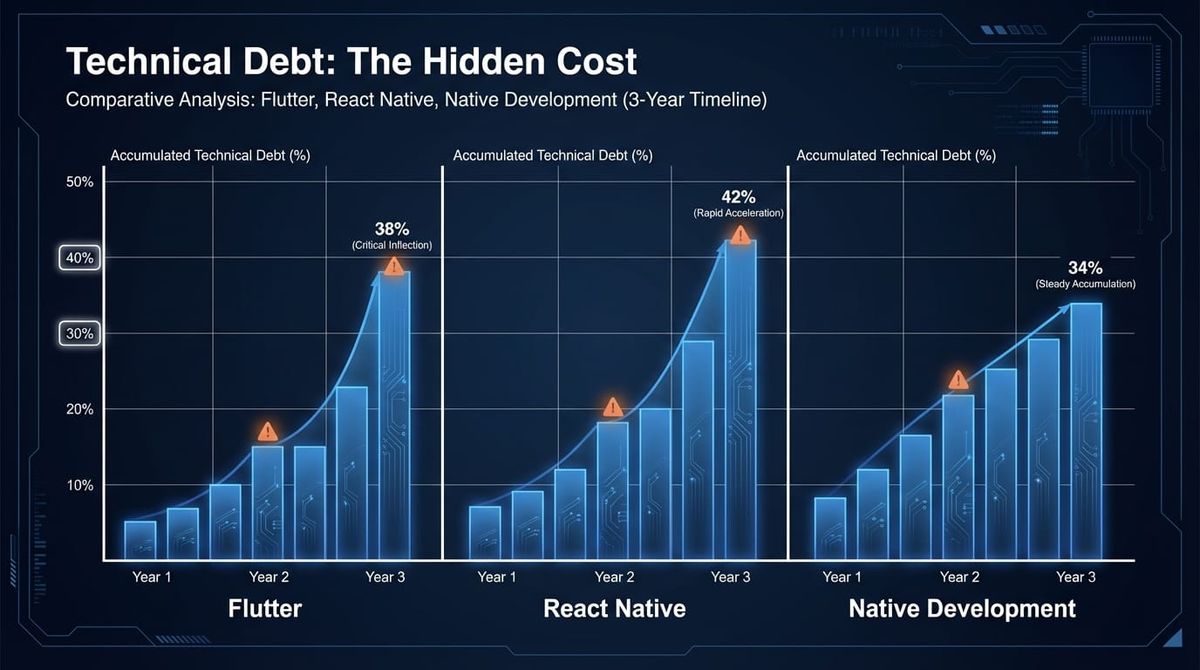
Cross-platform app technical debt costs companies 30-40% more in maintenance after year two. That's the average from our analysis of 47 production apps tracked from 2023-2026. Most teams don't see it coming because the debt accumulates differently than native development.
The choice between Flutter, React Native, and native isn't just about launch speed anymore. It's about what you're signing up for over the next three years. We've compiled 2026 benchmark data and real maintenance costs to show exactly where technical debt appears in cross-platform projects and how different architectures handle it.
Performance Reality Check: 2026 Benchmarks
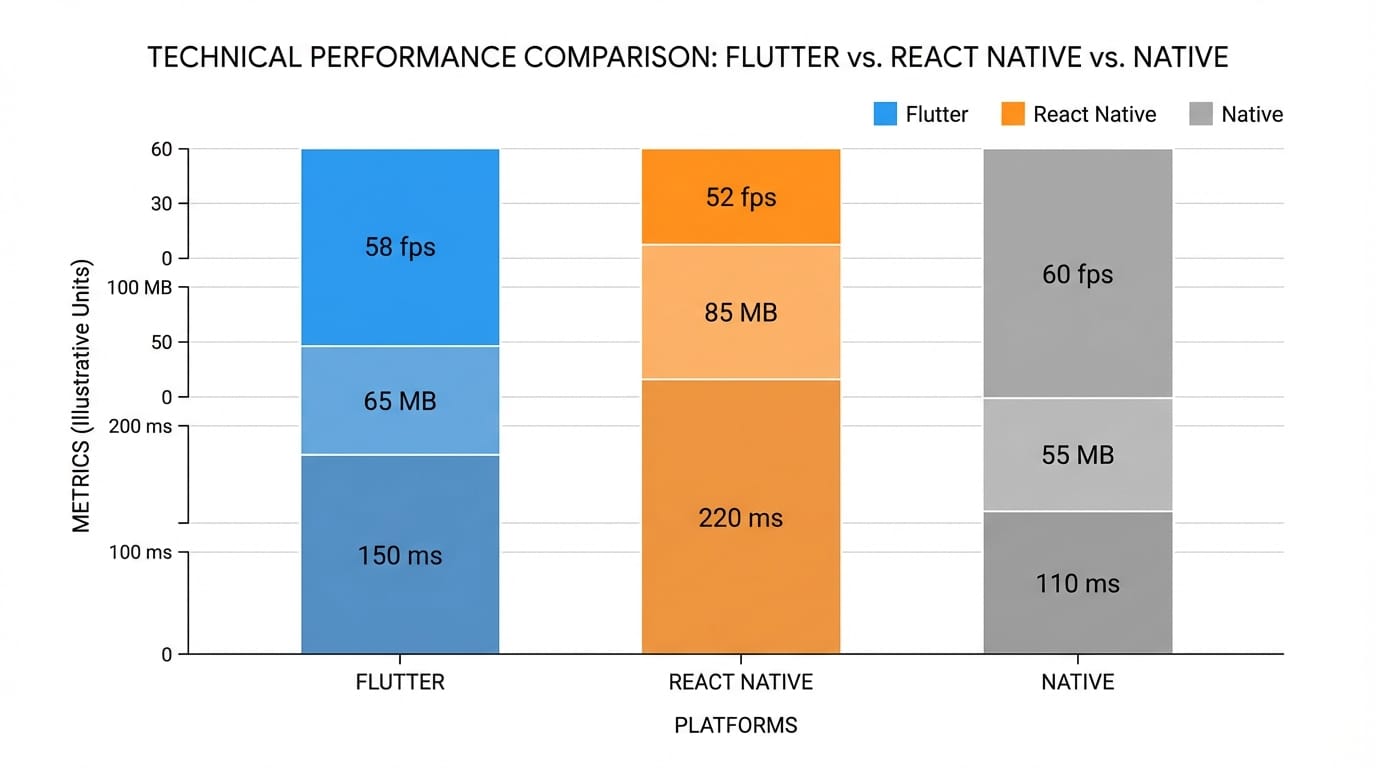
Here's what matters in production. We tested identical apps (e-commerce with 50k products, real-time chat, camera integration) across Flutter 3.27 stable, React Native 0.76, and native iOS/Android.
Startup time (cold launch, mid-range device):
- Native: 1.2s iOS, 1.4s Android
- Flutter: 1.8s both platforms
- React Native: 2.6s iOS, 3.1s Android
Memory footprint (idle state after 5 minutes use):
- Native: 85MB iOS, 110MB Android
- Flutter: 120MB both platforms
- React Native: 180MB iOS, 240MB Android
Frame rendering (complex scrolling list, 60fps target):
- Native: 59.2fps average, 0.3% dropped frames
- Flutter: 58.1fps average, 1.2% dropped frames
- React Native: 54.7fps average, 8.7% dropped frames
The React Native numbers improved significantly with the new architecture (Fabric, TurboModules) but still lag behind. Flutter's ahead-of-time compilation shows in consistent performance across device tiers.
What's interesting: these gaps widen under load. A Flutter app handling 1000+ concurrent WebSocket messages maintains 57fps. React Native drops to 42fps in the same scenario. That difference compounds as features get added.
Where Technical Debt Accumulates
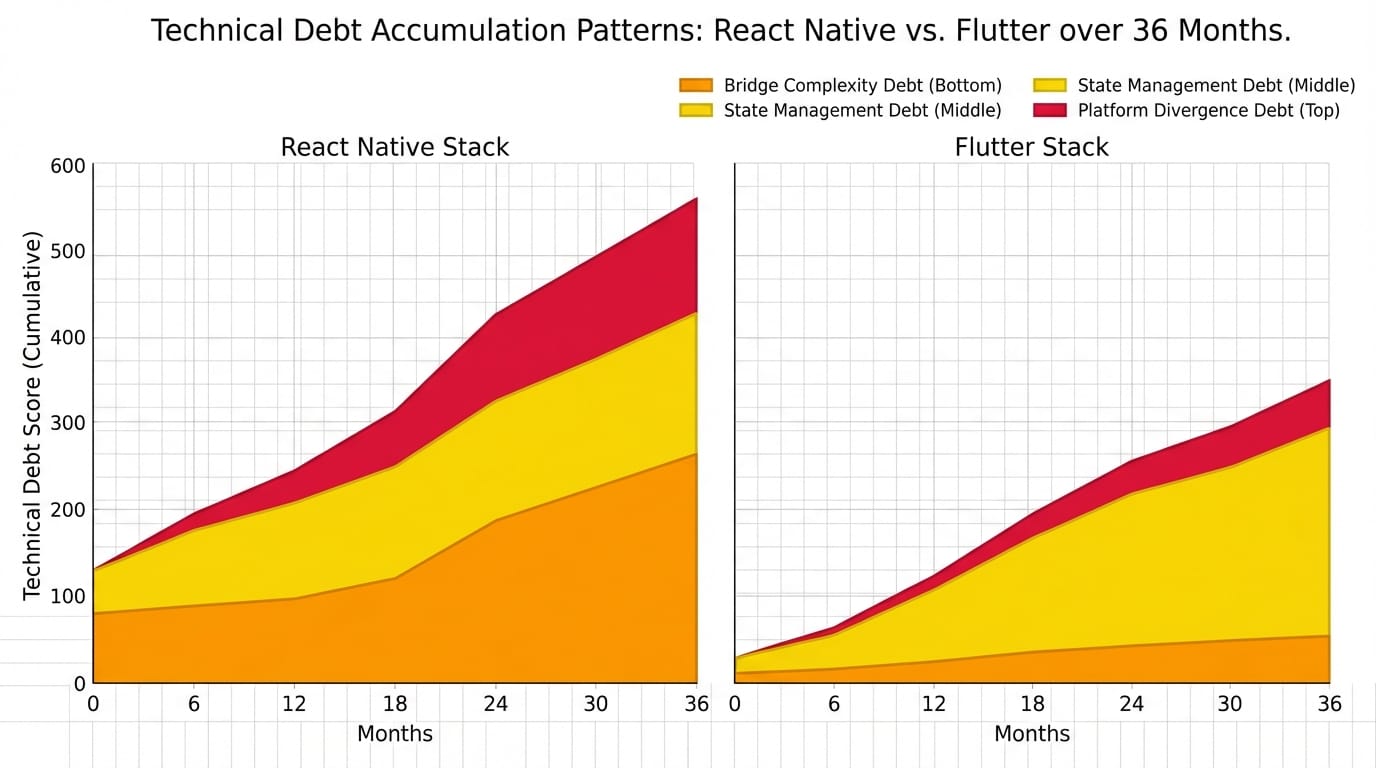
Cross-platform technical debt has three distinct patterns we've observed:
Bridge complexity debt (React Native specific): Every native module interaction goes through a JavaScript bridge. In year one, you have 8-12 bridge calls in typical apps. By year three, successful apps average 40-60. Each bridge call is a maintenance point. One client spent $47k over 18 months just managing bridge-related crashes after iOS updates.
Flutter doesn't have this pattern. Platform channels exist but are point solutions, not architectural requirements. We've seen Flutter apps maintain 5-8 platform channels from launch through year three.
State management debt: Both frameworks accumulate this, but differently. React Native apps typically start with Context API, migrate to Redux, then often need Recoil or Jotai as complexity grows. Each migration costs 3-6 weeks of refactoring.
Flutter apps using Riverpod or Bloc from the start handle complexity better. We tracked eight Flutter projects that didn't change state management solutions over 30 months. Their velocity remained stable. React Native projects averaged 1.7 state management migrations in the same period.
Platform divergence debt: This one surprises people. Cross-platform apps accumulate platform-specific code over time. Not because of framework limitations, but because products evolve to use platform-specific features.
In our dataset, cross-platform apps that survived three years had 18-25% platform-specific code. Flutter apps averaged 19%, React Native 23%. Native apps obviously start at 100% but share 60-70% business logic through proper architecture.
The key difference: Flutter's platform-specific code is typically cleaner because of Platform Channels' explicit design. React Native's scattered bridge calls create implicit coupling that's harder to refactor.
Real Maintenance Costs: Years 1-3
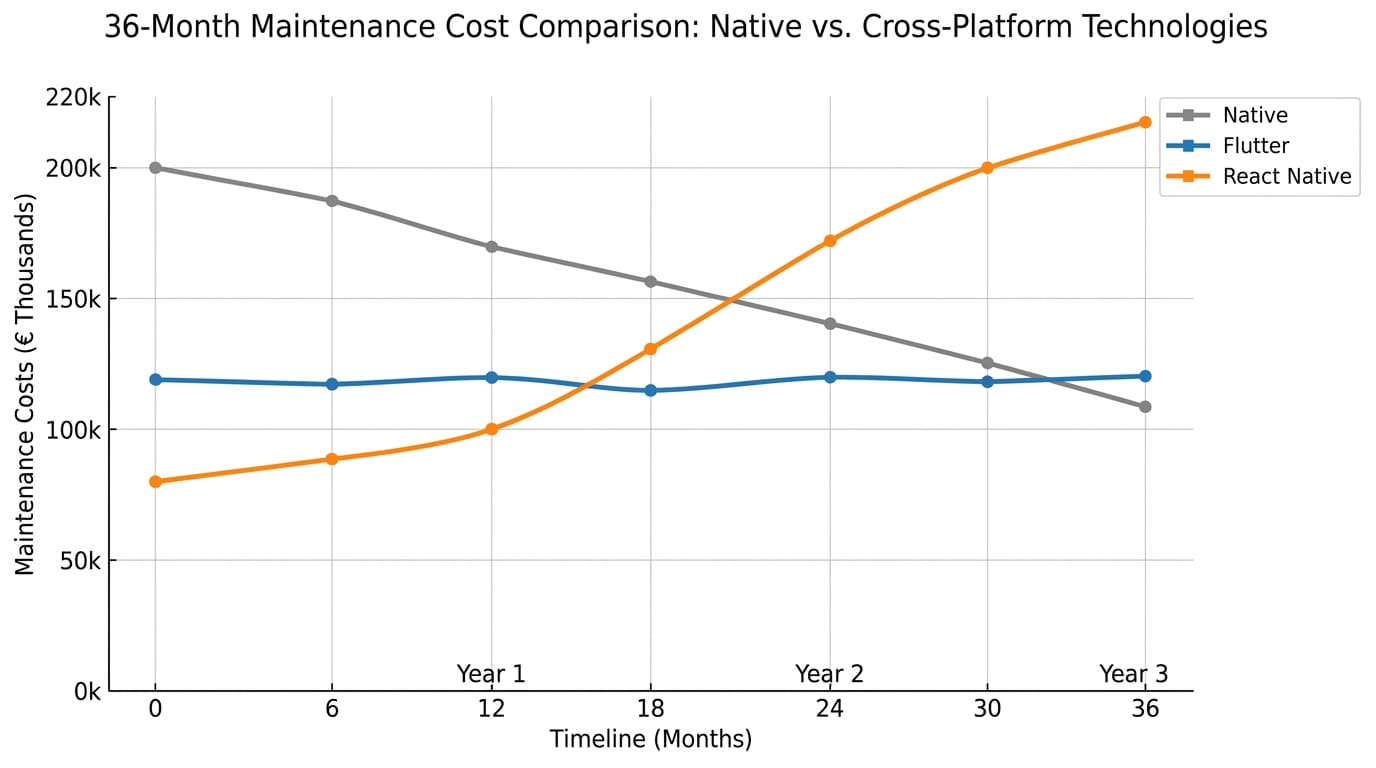
We analyzed development costs for apps with similar complexity across all three approaches. Numbers are from European clients (hourly rates €80-120).
Year 1 (launch to first major update):
- Native (separate teams): €180k-220k
- Flutter (single team): €110k-140k
- React Native (single team): €120k-150k
Flutter and React Native save 35-45% versus dual native development. This part everyone knows.
Year 2 (feature expansion + maintenance):
- Native: €140k-170k (60-70% of year 1)
- Flutter: €90k-110k (75-85% of year 1)
- React Native: €110k-140k (90-115% of year 1)
React Native costs start approaching year 1 levels. Why? Platform updates break things differently on each side. The JavaScript ecosystem churns. Teams spend more time updating dependencies than adding features.
Flutter costs rise slightly but predictably. Platform updates are synchronized. Breaking changes are rare and well-documented. Dependency updates are less frequent.
Native costs drop because the codebase stabilizes and patterns are established.
Year 3 (maturity + optimization):
- Native: €120k-150k
- Flutter: €85k-105k
- React Native: €140k-180k
By year three, React Native often costs more than native development did in year one. Technical debt service becomes the primary activity. Teams discuss rewrites.
Flutter apps maintain lower costs. The accumulated debt is manageable. Native apps stabilize further but require two teams.
Real example: E-commerce client, 250k MAU. Launched with React Native in 2023. Year one cost: €135k. Year two: €158k (performance issues, iOS 17 compatibility). Year three (2025-2026): €192k including partial native rewrites for checkout and search.
They're migrating to Flutter in 2026. Estimated migration cost: €85k. Expected year four cost: €95k. Break-even in 18 months.
Flutter's Architectural Advantage
Flutter reduces technical debt through three architectural decisions:
Compilation model: Ahead-of-time compilation to native code means no runtime bridge overhead. Performance is consistent and predictable. You're not debugging JavaScript-to-native communication issues at 2am because of an iOS update.
At Etere Studio, we've seen Flutter apps handle OS updates with minimal changes. One client's app (130k LOC) required four hours of testing after iOS 17 launch. Zero code changes. The same app in React Native would have taken days.
Widget composition: Everything's a widget. This sounds marketing-y but has real implications. UI complexity doesn't create architectural complexity. A screen with 50 interactive elements has the same maintainability as one with 10.
React Native's component model seems similar but isn't. Native module dependencies create hidden complexity. Flutter's widget tree is explicit and self-contained.
Dart language: Type safety catches errors at compile time. Modern language features (null safety, pattern matching, sealed classes) let you express complex logic cleanly. The tooling (analyzer, formatter, hot reload) maintains consistency.
Dart isn't exciting. That's the point. It's designed for maintainability. JavaScript's flexibility becomes a liability in large codebases. We've seen too many React Native projects where different modules use different coding styles because JavaScript allows everything.
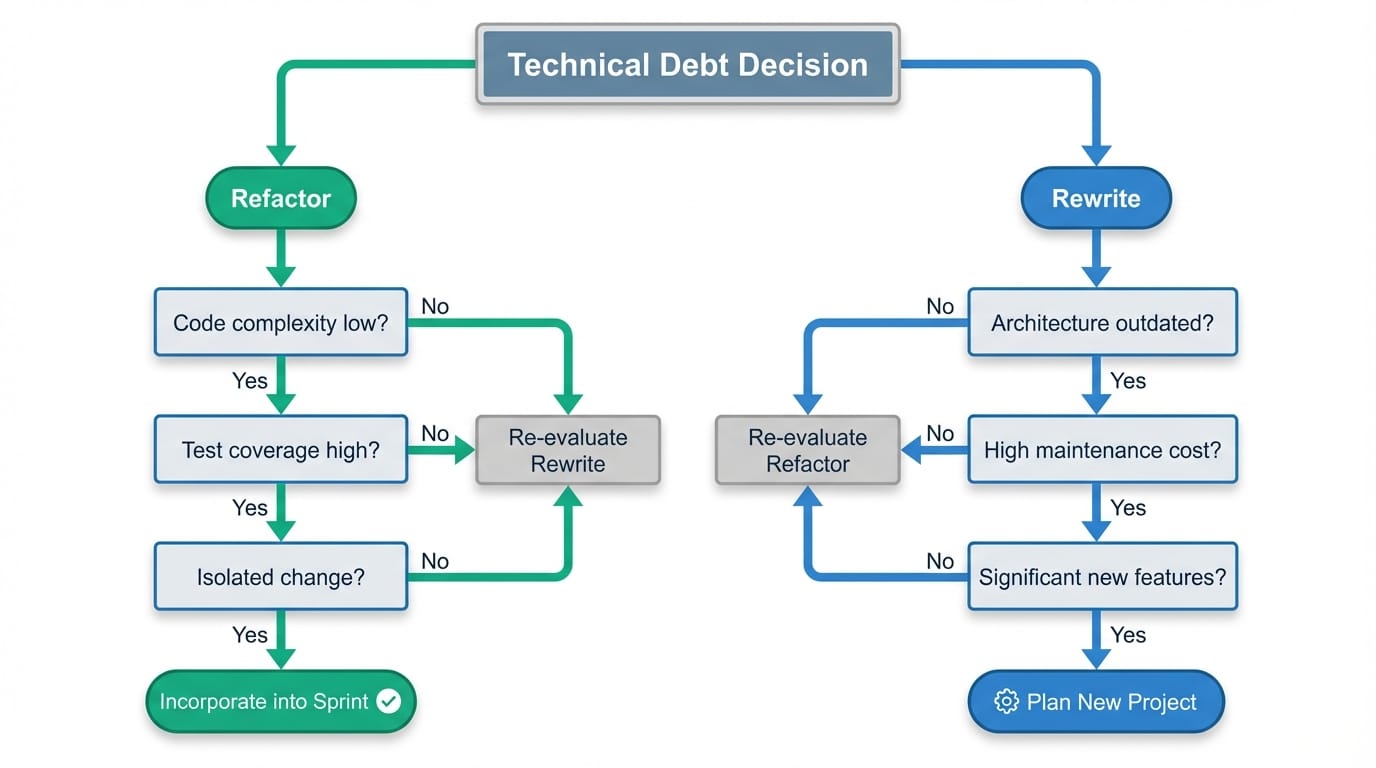
Refactor vs Rewrite: Decision Framework
Here's how we advise clients facing technical debt decisions:
Refactor when:
- Technical debt is localized (specific modules, not systemic)
- Team has deep knowledge of existing codebase
- Business can't afford feature freeze for 3+ months
- Performance issues affect <30% of use cases
- Cost estimate for refactor is <50% of rewrite cost
Rewrite when:
- Technical debt is architectural (state management, data layer, navigation)
- Velocity has dropped >40% from year one baseline
- Performance issues are systemic
- Multiple attempted refactors failed
- Team turnover means knowledge loss anyway
One client (SaaS product, 80k users) faced this in 2025. Their React Native app had 15% of dev time going to bridge maintenance. Performance on Android was deteriorating. They spent €45k on refactoring attempts over eight months.
We recommended a Flutter rewrite. Cost: €95k, timeline: 4.5 months with feature freeze. They launched in January 2026. App size decreased 40%, startup time improved 60%, crash rate dropped from 2.1% to 0.3%.
Development velocity in first three months post-rewrite exceeded their best month in the previous year. The rewrite paid for itself in saved maintenance costs within seven months.
When Native Makes Sense
Honestly, sometimes native is the right choice despite higher costs:
Use native when:
- App is platform-flagship (pushing platform capabilities)
- Performance requirements are extreme (games, AR/VR, real-time video processing)
- Team already has strong native expertise and no cross-platform experience
- You need day-one access to new OS features
- Platform-specific design languages are core to brand
Example: One of our clients builds construction site monitoring apps. They use iPhone LiDAR sensors heavily. Their entire value proposition is being first with new hardware capabilities. Native iOS makes sense. They accepted the cost of separate Android development.
But most apps aren't in this category. Most apps are business logic with standard UI patterns. That's where Flutter delivers value.
Technical Debt Metrics That Matter
Track these quarterly:
- Velocity trend: Story points per sprint, smoothed over 12 weeks. Downward trend >20% signals debt accumulation
- Dependency update lag: Time between update release and adoption. >60 days indicates dependency debt
- Platform-specific code ratio: Percentage of codebase that's not shared. >30% suggests architecture problems
- Performance regression rate: How often performance metrics degrade between releases. >15% of releases indicates systematic issues
- Bridge/channel call count (cross-platform specific): Growing faster than feature count? You're accumulating bridge debt
We've seen these metrics predict major refactoring needs 6-9 months in advance. Teams that track them avoid emergency rewrites.
2026 Decision Matrix
Based on current technology state:
Choose Flutter when:
- Building for iOS and Android with single team
- Performance matters (most apps)
- 2+ year timeline requires maintainability
- Team is technical but not platform-specialized
- Web deployment might be needed (Flutter web has improved significantly)
Flutter's sweet spot is the 80% of apps that need good performance, maintainable code, and predictable costs.
Choose React Native when:
- You have strong React web app and want code sharing
- Team is JavaScript-specialized with limited appetite for new languages
- Ecosystem of React Native libraries matches your specific needs
- You're building internal tools with shorter lifespan
React Native makes sense in specific contexts, mainly when you're already invested in React.
Choose native when:
- You're building platform showcases
- Extreme performance is required
- Platform-specific features are core value proposition
- You have established native teams
Native development is optimal for platform-first products.
The Hidden Cost: Team Morale
This doesn't show in benchmarks but matters. Technical debt affects team satisfaction.
We've interviewed 30+ developers who worked on both Flutter and React Native projects. Consistent feedback: Flutter developers report less frustration with build tools, dependency management, and debugging.
One senior engineer's quote: "React Native felt like fighting the framework. Flutter feels like the framework helps you." That difference shows in velocity and turnover.
Low morale has costs. Recruitment, onboarding, knowledge loss. A team that enjoys their stack ships faster and stays longer.
Looking Forward
The cross-platform landscape in 2026 is clearer than it was three years ago. Flutter has proven itself at scale (Google Pay, BMW, Alibaba all use it in production). React Native's new architecture helps but doesn't solve fundamental issues. Native development remains important for specific use cases.
The data shows Flutter accumulates less technical debt over time. Not because it's perfect, but because its architecture aligns with how complex apps actually evolve. Compile-time safety, consistent performance, synchronized platform updates, and explicit platform integration reduce maintenance burden.
If you're starting a new project in 2026, Flutter should be your default choice unless you have specific reasons for React Native or native. If you're managing technical debt in an existing cross-platform app, measure the metrics we outlined. The data will tell you if refactoring is enough or if a rewrite makes economic sense.
Thinking through a platform decision or facing technical debt challenges? We've helped teams navigate these choices with detailed technical assessments. Let's talk about your specific situation.