
Mobile App Development Costs in 2025: What You'll Actually Pay from MVP to Full Product
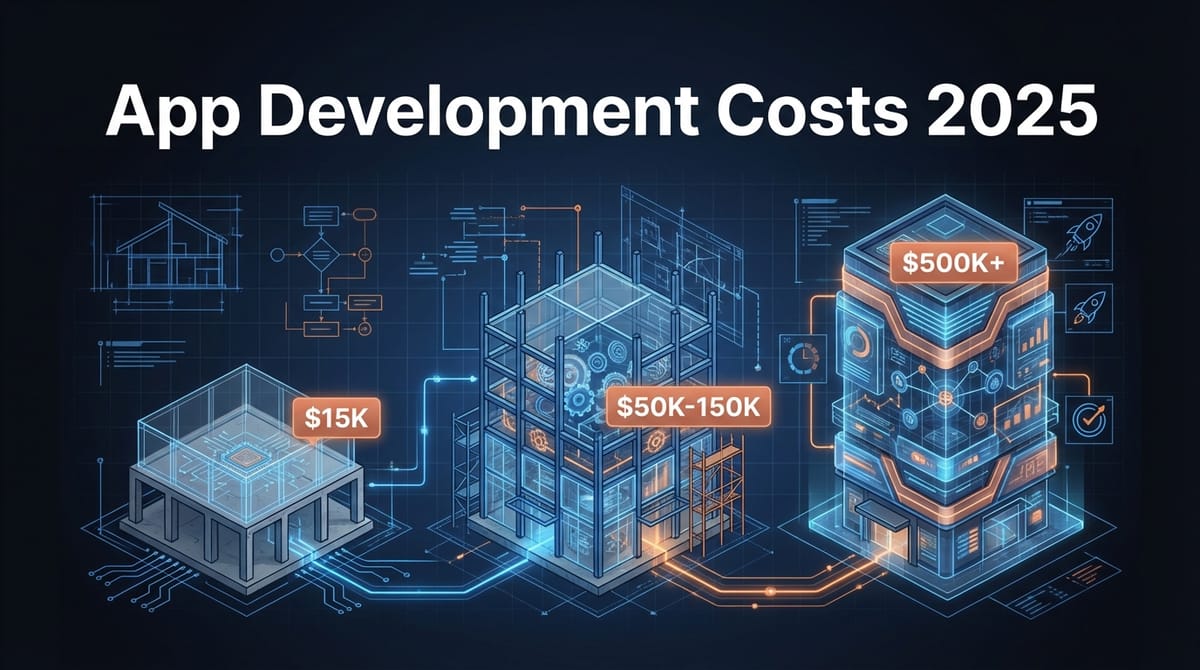
The honest answer to "how much does an app cost" is somewhere between $15,000 and $500,000+. Not helpful, right? The range exists because "an app" can mean anything from a three-screen MVP to a full-scale platform with real-time features, payments, and admin dashboards.
At Etere Studio, we've quoted projects across that entire spectrum. The difference isn't just features—it's scope decisions, technical choices, and where you hire. This breakdown covers what actually drives app development cost in 2025, with real numbers you can use for budgeting.
MVP vs Full Product: The Scope Gap That Changes Everything
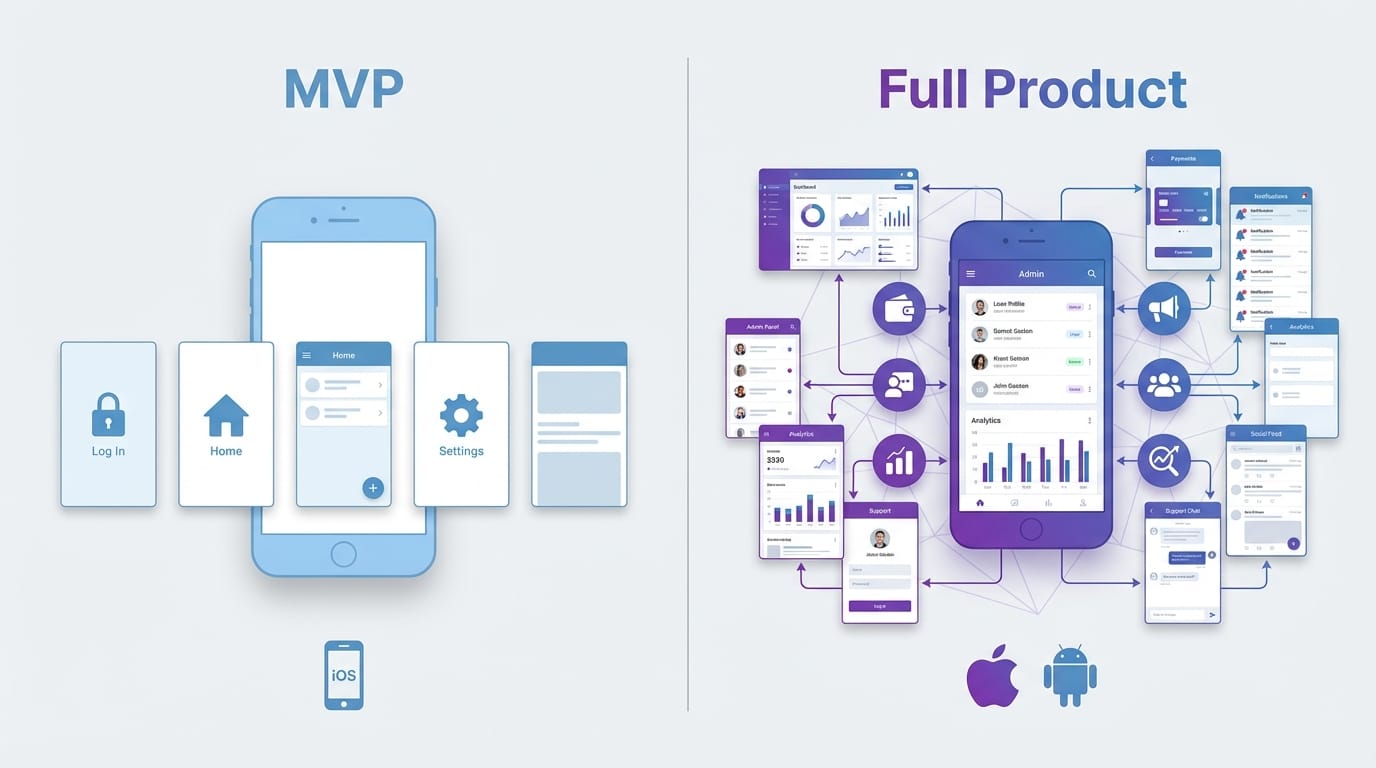
The biggest cost factor isn't technology or location—it's what you're actually building. An MVP and a full product can look similar on paper but differ by 3-5x in development time.
MVP scope typically includes:
- Core user flow (3-7 screens)
- Basic authentication
- Essential features only (usually 1-2)
- Simple backend or BaaS solution
- One platform (iOS or Android, not both)
- Basic UI without custom animations
Full product scope adds:
- Complete feature set (10-30+ screens)
- Advanced authentication (social login, 2FA)
- Multiple user roles and permissions
- Custom backend with admin dashboard
- Both platforms with platform-specific optimizations
- Polished UI with animations and micro-interactions
- Third-party integrations (payments, analytics, notifications)
- Offline support, caching, performance optimization
A social app MVP might let users create profiles and post content. The full product adds messaging, notifications, content moderation, reporting, search, recommendations, and admin tools. Same "social app"—completely different projects.
Real example from our work: A client came to us wanting a "simple" e-commerce app. Their initial feature list would've been $180,000+. We scoped an MVP with product browsing, cart, and Stripe checkout for $45,000. They launched in 8 weeks, validated demand, then expanded.
Regional Rates: Where You Hire Changes the Math
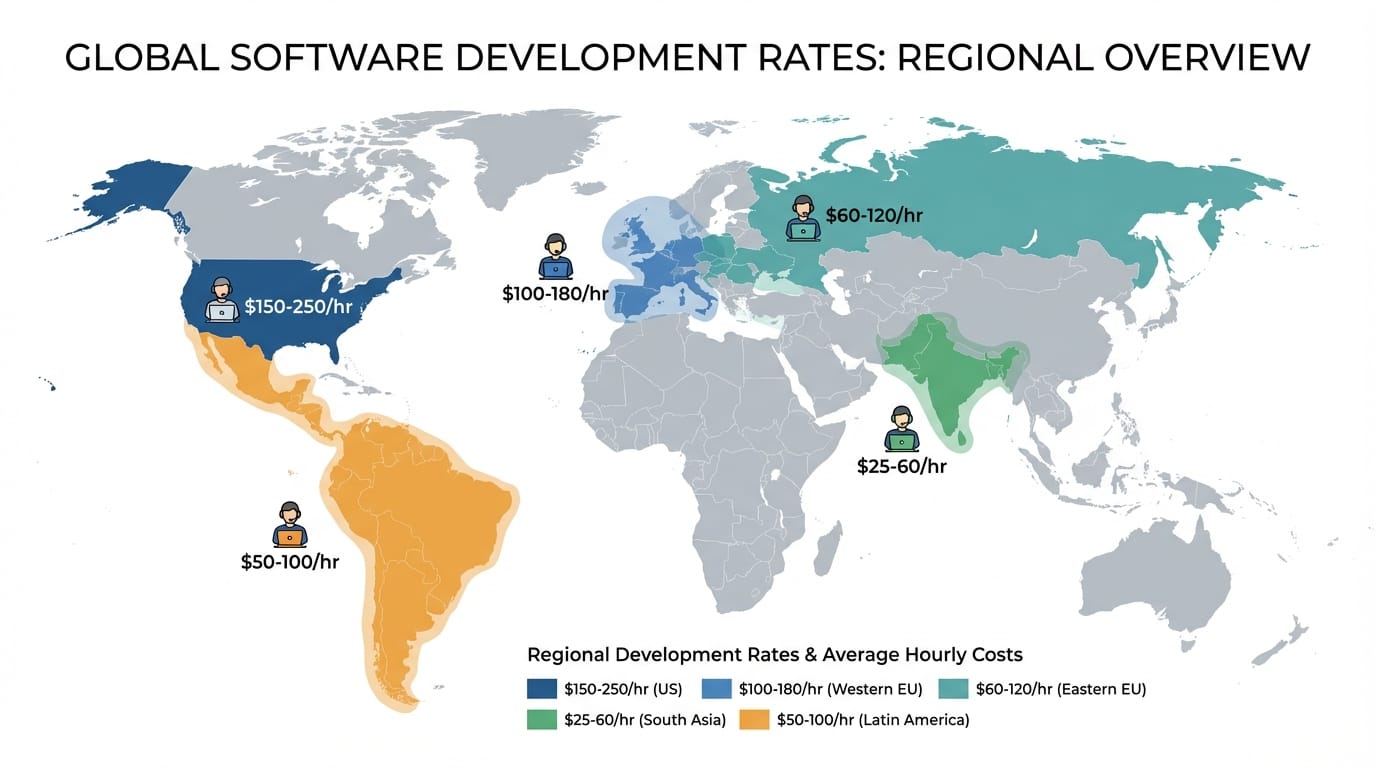
Hourly rates vary dramatically by region. Here's what we see in 2025:
| Region | Junior Dev | Mid-Level | Senior Dev | Agency Rate |
|---|---|---|---|---|
| US | $80-120 | $120-180 | $180-250+ | $150-300 |
| Western EU | $60-90 | $90-140 | $140-200 | $100-200 |
| Eastern EU | $35-55 | $55-85 | $85-130 | $60-120 |
| South Asia | $15-30 | $30-50 | $50-80 | $25-60 |
| Latin America | $30-50 | $50-80 | $80-120 | $50-100 |
These aren't just numbers—they represent different trade-offs.
US/Western EU agencies charge premium rates but typically offer better communication, overlap with your timezone, and more predictable project management. You're paying for reduced coordination overhead.
Eastern EU (where we operate) hits a sweet spot: strong technical education, cultural alignment with Western clients, reasonable timezone overlap, and rates 40-60% lower than Western EU.
South Asia offers the lowest rates, but we've seen clients spend savings on extended timelines, rework, and communication overhead. It works well for clearly specified projects with experienced technical oversight on your side.
The real calculation: A $100/hour US agency building a $150,000 app might deliver in 1,500 hours. A $50/hour Eastern EU agency might take 1,800 hours (more communication overhead) for $90,000. A $30/hour South Asian team might take 2,500 hours with rework, landing at $75,000—but 4 months later.
Flutter vs Native: The Cost Multiplier
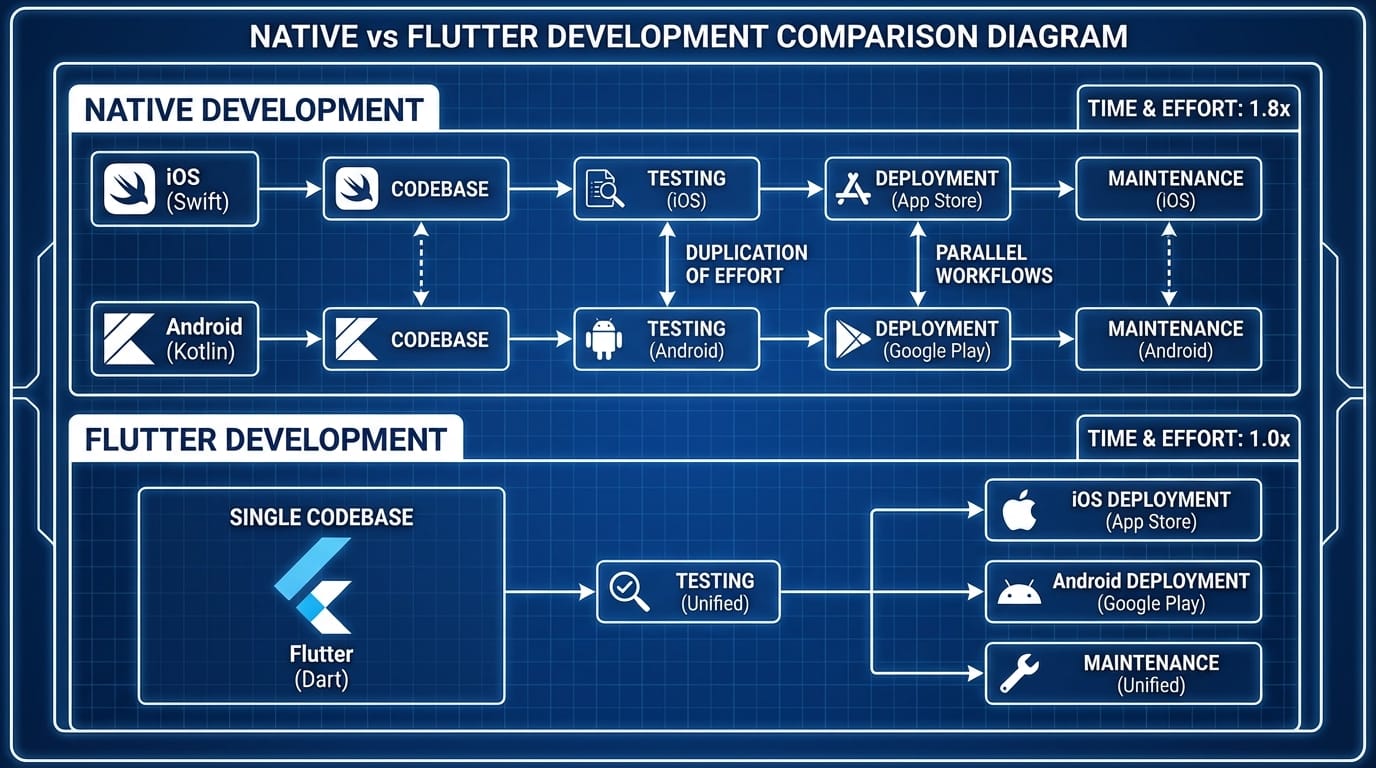
This is where technical decisions directly impact budget. Building native apps means two separate codebases—one for iOS (Swift), one for Android (Kotlin). Cross-platform frameworks like Flutter let you ship both from one codebase.
Native development costs:
- Two development teams or developers
- Roughly 1.8x the development time of single platform
- Separate testing and QA for each platform
- Ongoing maintenance for two codebases
Flutter development costs:
- Single codebase, single team
- 1.0-1.2x the development time of single platform
- Unified testing
- One codebase to maintain
Practical impact: A native app quoted at $120,000 (iOS + Android) typically costs $70,000-85,000 in Flutter. Not quite half—there's still platform-specific work—but significant savings.
At Etere Studio, we've seen Flutter reduce timelines by 35-45% compared to native dual development. For a startup with runway concerns, that's not just cost savings—it's faster time to market and earlier revenue.
When native still makes sense:
- Apps requiring cutting-edge platform features (AR, certain hardware integrations)
- Games with complex graphics (though Flutter handles most use cases now)
- Companies with existing native teams
- Apps where platform-specific UX is a core differentiator
For 80%+ of business apps, Flutter delivers equivalent quality at lower cost. We've built e-commerce apps, productivity tools, and social platforms in Flutter that users can't distinguish from native.
Hidden Costs: The Budget Items People Forget
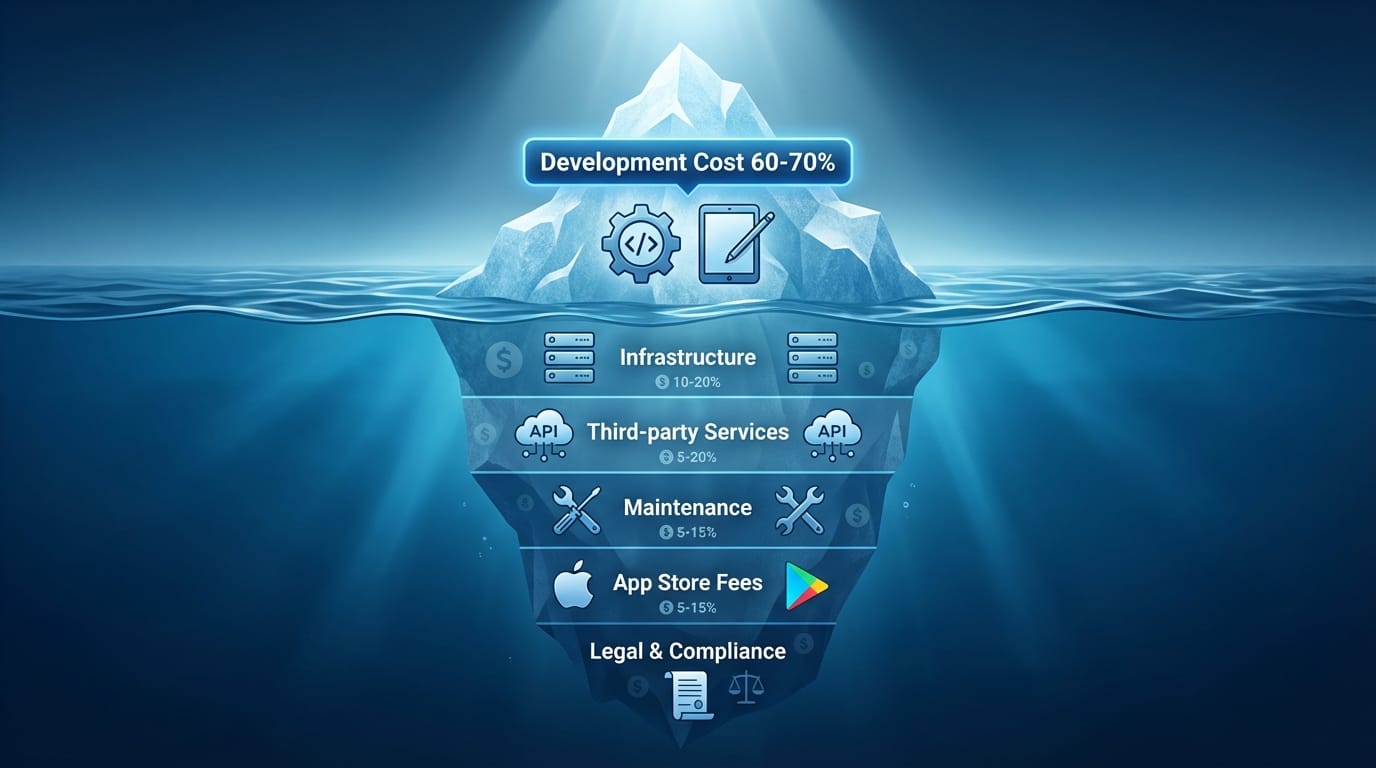
Development is typically 60-70% of first-year costs. Here's what else you'll pay:
Infrastructure and hosting: $100-2,000+/month
- Cloud hosting (AWS, Google Cloud, Firebase): $50-500/month for MVP, $200-2,000+ at scale
- Database costs scale with users and data
- CDN for media-heavy apps: $20-200/month
- SSL certificates, domain: $50-200/year
Third-party services: $100-1,000+/month
- Push notifications (OneSignal, Firebase): Free tier usually sufficient early, $100-500/month at scale
- Analytics (Mixpanel, Amplitude): $0-1,000/month depending on events
- Error tracking (Sentry, Crashlytics): $0-100/month
- Email services (SendGrid, Mailgun): $20-200/month
App store fees:
- Apple Developer Program: $99/year
- Google Play Developer: $25 one-time
- Apple's 15-30% commission on in-app purchases
- Google's 15-30% commission on in-app purchases
Ongoing maintenance: 15-25% of development cost annually
- Bug fixes and stability updates
- OS compatibility updates (iOS and Android release annually)
- Security patches
- Minor feature adjustments
Often overlooked:
- Design costs if not included in development quote: $5,000-30,000
- Legal (privacy policy, terms of service): $1,000-5,000
- App store optimization and screenshots: $500-2,000
- User testing and QA beyond development: $2,000-10,000
First-year total cost formula:
Development + (Monthly services × 12) + Maintenance + Store fees + Design + Legal
For a $60,000 MVP: $60,000 + $3,600 + $12,000 + $124 + $8,000 + $2,000 = ~$86,000 first year
Real Ballpark Ranges by App Type
These ranges assume Flutter development with a mid-tier agency (Eastern EU or experienced Latin American team). Adjust up 50-80% for US agencies, down 30-40% for South Asian teams.
Simple utility app (calculator, converter, single-purpose tool)
- MVP: $8,000-15,000
- Full product: $15,000-30,000
- Timeline: 3-6 weeks MVP, 6-10 weeks full
E-commerce app
- MVP (browse, cart, checkout): $35,000-55,000
- Full product (inventory, orders, admin, reviews, recommendations): $80,000-150,000
- Timeline: 8-12 weeks MVP, 16-24 weeks full
Social/community app
- MVP (profiles, posts, basic feed): $40,000-65,000
- Full product (messaging, notifications, moderation, search, recommendations): $100,000-200,000
- Timeline: 10-14 weeks MVP, 20-32 weeks full
Marketplace (two-sided)
- MVP (listings, search, basic transactions): $50,000-80,000
- Full product (reviews, disputes, payments, dashboards for both sides): $120,000-250,000
- Timeline: 12-16 weeks MVP, 24-40 weeks full
On-demand service app (Uber-style)
- MVP (booking, tracking, basic payments): $60,000-100,000
- Full product (real-time tracking, driver app, admin, surge pricing, ratings): $150,000-300,000
- Timeline: 14-20 weeks MVP, 28-44 weeks full
Productivity/SaaS mobile app
- MVP: $30,000-50,000
- Full product: $70,000-140,000
- Timeline: 8-12 weeks MVP, 16-28 weeks full
Healthcare app (with compliance)
- MVP: $50,000-80,000
- Full product: $120,000-250,000+
- Timeline: 12-18 weeks MVP, 24-40 weeks full
- Note: HIPAA/GDPR compliance adds 20-40% to costs
Decision Framework: Choosing Your Approach
Use this to match your situation to the right development strategy:
Start with MVP if:
- You haven't validated core assumptions with real users
- Runway is under 18 months
- You're entering an established market and need to test differentiation
- Your feature list has more than 5 "must-haves"
Go straight to full product if:
- You have validated demand (waitlist, pre-orders, existing web users)
- Regulatory requirements mandate certain features
- You're replacing an existing system with known requirements
- Competitive landscape requires feature parity to enter
Choose Flutter if:
- You need both iOS and Android
- Budget is a constraint
- Time to market matters
- Your app is content/data-focused rather than hardware-focused
Choose native if:
- You only need one platform (rare but valid)
- Cutting-edge platform features are core to your product
- You have existing native expertise in-house
- Performance requirements are extreme (games, video processing)
Choose US/Western EU agency if:
- Communication and timezone alignment are critical
- You lack technical oversight capability
- Budget allows for premium rates
- Regulatory or contractual requirements mandate it
Choose Eastern EU/Latin America if:
- You want quality-cost balance
- You can handle some timezone offset
- You have basic technical literacy to evaluate work
Choose South Asia if:
- Specifications are extremely detailed and fixed
- You have strong technical oversight
- Budget is primary constraint
- Timeline flexibility exists
Getting Accurate Quotes
When you approach agencies, the quality of your brief determines quote accuracy. Vague briefs get wide ranges. Detailed briefs get precise estimates.
Include in your brief:
- User types and their core actions
- Screen list or rough wireframes
- Must-have vs nice-to-have features
- Integrations needed (payment, social, analytics)
- Timeline constraints
- Budget range (yes, sharing this helps—agencies can scope to fit)
Red flags in quotes:
- Fixed price with no discovery phase
- No mention of what's excluded
- Significantly below market rate without explanation
- Timeline that seems too fast for scope
- No breakdown by phase or feature
Green flags:
- Discovery/scoping phase offered
- Clear assumptions stated
- Phased approach with decision points
- Maintenance and support terms included
- References or portfolio for similar projects
App development cost ultimately comes down to scope discipline. The most expensive apps aren't the complex ones—they're the ones where scope grew unchecked. Start with what you need to learn, not what you imagine the final product looks like.
Planning a mobile app and want a realistic estimate? We're happy to review your concept and give you honest numbers. Get in touch.